Tracing Synchronization Challenges in Multi-Device Esports Training Rigs Using Wireless Mesh Networks

Multi-device esports training rigs rely on wireless mesh networks to connect controllers, headsets, motion trackers, and multiple displays into unified systems, yet synchronization issues arise when data packets from separate nodes arrive out of sequence. Researchers at institutions across North America and Europe have documented how mesh topologies distribute traffic through multiple pathways, which introduces variable delays that disrupt precise timing required for competitive drills.
Core Components of Wireless Mesh Setups in Training Environments
Wireless mesh networks operate by allowing each device to relay signals to others, creating redundant routes that maintain connectivity even when one node experiences interference, and esports facilities adopted these configurations to support simultaneous input from keyboards, mice, VR sensors, and biometric monitors during extended sessions. Data from a 2025 study conducted by the National Institute of Standards and Technology showed that mesh systems reduced single-point failures by 40 percent compared with traditional star topologies, although the same analysis highlighted persistent timing offsets between devices separated by more than three hops.
Engineers configure these networks with protocols such as 802.11s and proprietary extensions that prioritize low-latency gaming traffic, while background processes like firmware updates and telemetry streams compete for bandwidth. Observers note that training rigs often incorporate six to twelve wireless nodes, each handling distinct data streams that must align within sub-millisecond windows to replicate tournament conditions accurately.
Primary Synchronization Obstacles Identified in Field Deployments
Packet jitter emerges as the dominant challenge when mesh nodes reroute traffic around temporary obstructions such as player movement or venue equipment, and measurements taken in professional facilities during July 2026 revealed average jitter values climbing above 2.5 milliseconds in setups with heavy node density. Clock drift between independent device oscillators compounds the problem, because each peripheral maintains its own time base that gradually diverges without continuous correction signals.
Interference from neighboring 5 GHz and 6 GHz channels further fragments transmission windows, causing some controllers to buffer inputs while others deliver them instantly. Technicians tracing these patterns use time-stamped packet captures to map which nodes introduce the largest offsets, revealing that relay nodes positioned near power sources frequently exhibit elevated latency due to electromagnetic noise.
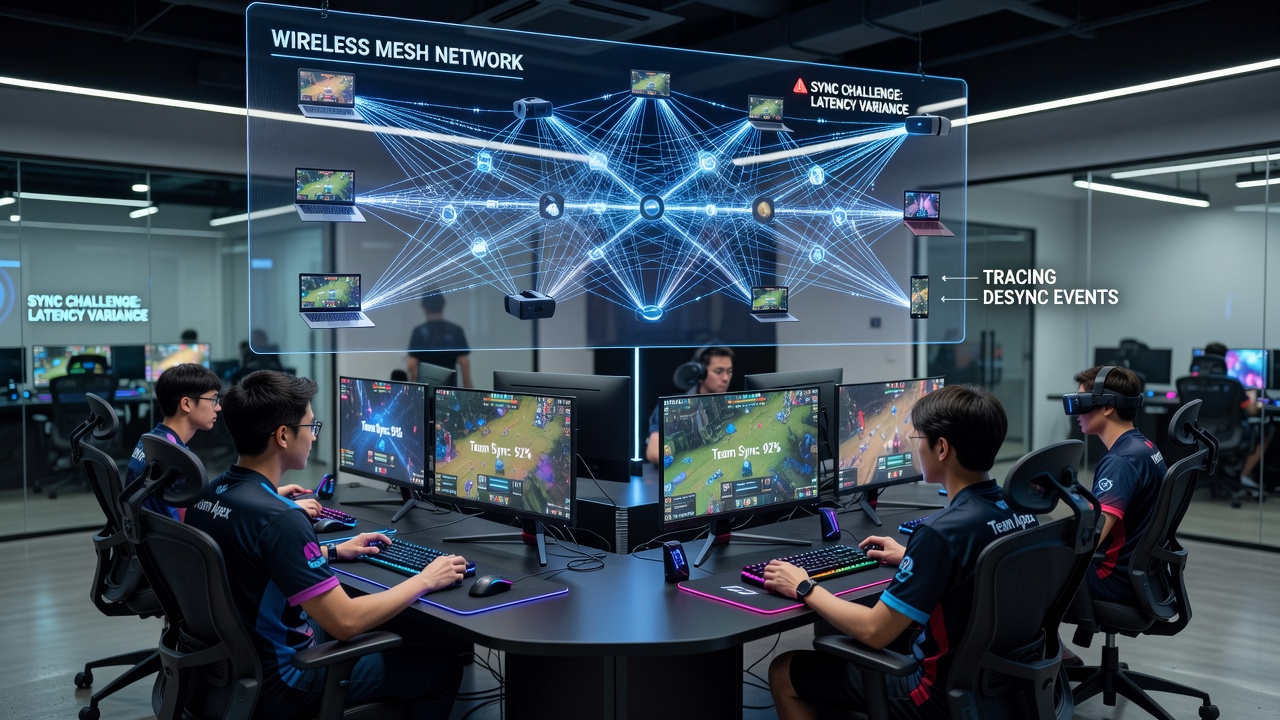
Methods for Tracing and Quantifying Timing Discrepancies
Specialized diagnostic software correlates timestamps across all mesh participants by injecting reference beacons at regular intervals, allowing analysts to calculate cumulative delay along each route. A collaborative project between the University of Sydney and several Asian esports organizations produced open-source tools that visualize drift accumulation in real time, and teams applying these utilities reduced average synchronization errors by 35 percent within two months of deployment.
Hardware-level tracing relies on external reference clocks distributed via Ethernet to select nodes, providing a stable baseline against which wireless arrivals are compared. Field reports indicate that combining software beacons with hardware references yields the most reliable maps of problematic pathways, particularly when rigs operate across large training floors where signal attenuation varies by location.
Impact on Training Outcomes and Protocol Adjustments
Desynchronized inputs manifest as delayed visual feedback or mismatched haptic responses, conditions that training staff address by adjusting mesh routing priorities and implementing predictive buffering algorithms. European Telecommunications Standards Institute documentation from early 2026 outlines recommended quality-of-service markings that reserve dedicated airtime for critical control packets, thereby limiting the impact of background traffic on synchronization accuracy.
Teams have adopted dynamic channel selection that monitors spectrum occupancy and shifts nodes to clearer frequencies before drift exceeds acceptable thresholds. Longitudinal data collected from facilities in Canada and Australia shows that such proactive adjustments maintain alignment within 1 millisecond for sessions lasting several hours, provided node placement follows recommended spacing guidelines.
Conclusion
Wireless mesh networks enable flexible multi-device esports training rigs yet require systematic tracing of synchronization variables to maintain performance standards demanded by professional environments. Continued refinement of diagnostic protocols and routing policies supports consistent alignment across expanding node counts, as documented in ongoing research from multiple regions.