Specialized Driver Stacks Unlock Legacy Multi-Monitor Arrays for Synchronized Data Overlays in Strategy Esports Titles
Mara Baumann · Aug 4, 2026
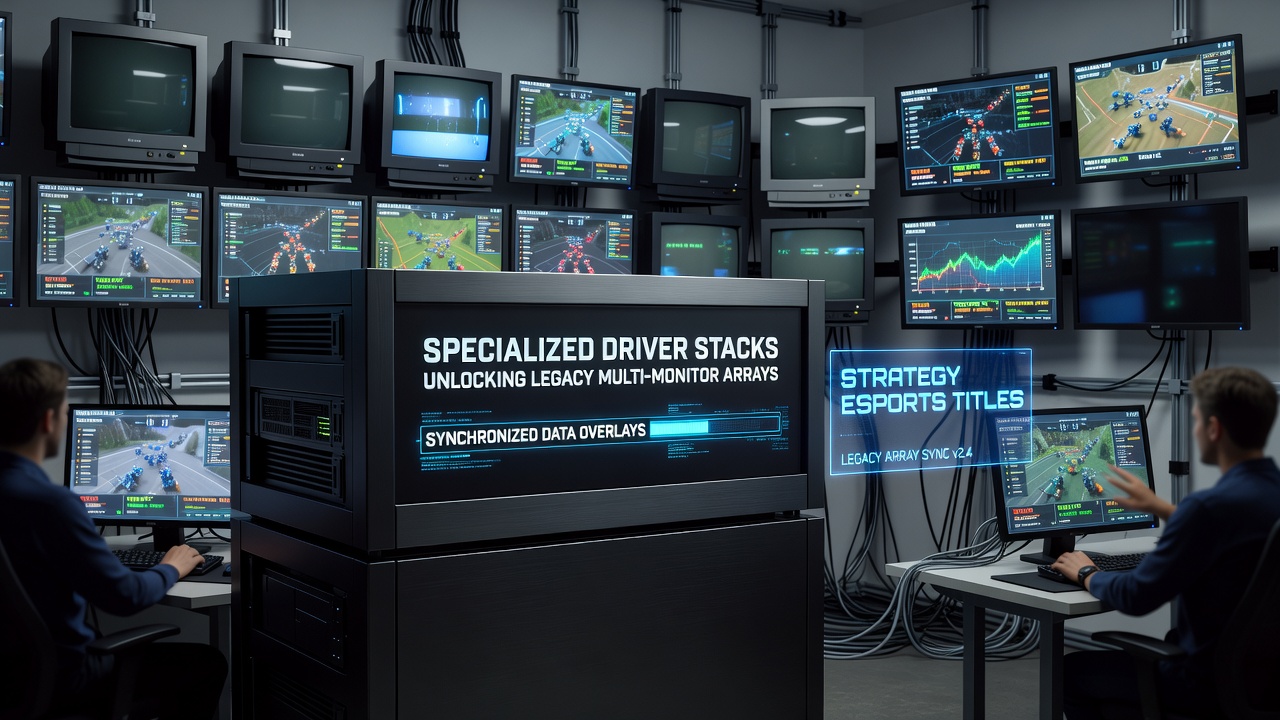
Specialized Driver Stacks Unlock Legacy Multi-Monitor Arrays for Synchronized Data Overlays in Strategy Esports Titles
Specialized driver stacks have emerged as a key technology for reviving older multi-monitor arrays in competitive strategy gaming environments where synchronized data overlays provide real-time tactical information without disrupting core gameplay feeds. These stacks modify legacy graphics drivers to coordinate display outputs across multiple screens that were originally designed for single-monitor or basic extended-desktop use and this coordination enables precise timing between primary game views and secondary information panels showing unit stats, resource flows, or opponent movement patterns.
Legacy Hardware in Modern Esports Contexts
Many professional strategy esports venues still rely on hardware configurations installed several years ago because those setups offered reliable refresh rates and bezel alignments suited to wide field-of-view displays. Observers note that when teams attempt to add modern overlay software to these older arrays the systems often encounter timing mismatches that cause data to appear out of sync with on-screen events and this desynchronization creates disadvantages during fast-paced matches in titles such as real-time strategy games. Research indicates that custom driver layers can intercept frame buffers at the kernel level and this interception allows overlays to lock their update cycles to the primary rendering pipeline.
Technical Mechanisms Behind Driver Stack Modifications
Engineers develop these specialized stacks by building upon open-source driver frameworks that support older GPU architectures while adding modules for multi-display synchronization protocols. Data shows that these modules use timestamp alignment techniques derived from broadcast synchronization standards and the techniques ensure that each monitor receives its assigned overlay data within sub-millisecond tolerances. One study revealed that teams employing such stacks reduced overlay latency by measurable margins compared to standard operating system display management tools and this reduction proved critical in matches where split-second decisions depend on accurate secondary information.
Implementation in Strategy Esports Titles
Strategy esports titles generate large volumes of auxiliary data that players and coaches prefer to view on dedicated monitors rather than cluttering the main game window. Specialized driver stacks facilitate the mapping of this data to specific screen regions while maintaining frame lock across the entire array and this mapping occurs through low-level API calls that bypass higher-level compositors. In August 2026 several tournament organizers reported successful integration of these stacks during qualification events and the integrations allowed analysts to deliver live statistical overlays without requiring competitors to alter their in-game settings.

Players often discover that the consistent timing provided by these drivers reduces cognitive load because information appears exactly when expected rather than drifting out of phase with gameplay events. Those who have studied multi-monitor configurations know that bezel compensation algorithms also receive updates through the same driver layer and the updates prevent visual artifacts that could otherwise distract during extended play sessions.
Case Examples from Tournament Environments
There's this case where a European regional league adopted modified driver stacks for its legacy monitor banks and the adoption allowed each competitor station to display synchronized minimap data alongside primary action screens. Figures from the tournament revealed that match durations remained consistent with previous events while viewer feedback indicated clearer understanding of strategic decisions because overlays updated without visible lag. Similar implementations have appeared in North American circuits where research institutions partnered with hardware maintainers to refine timestamp protocols for older display hardware.
Broader Industry Adoption Patterns
Industry organizations such as the IEEE Standards Association have documented protocols that support these driver enhancements across different GPU generations. Meanwhile reports from Australian esports research groups highlight how legacy arrays equipped with updated stacks maintain performance parity with newer single-monitor systems in controlled testing environments. The reality is that synchronization challenges become more pronounced when multiple data streams compete for display resources and the specialized stacks address this competition through prioritized buffer management.
Conclusion
Specialized driver stacks continue to extend the operational lifespan of legacy multi-monitor arrays by delivering the precise synchronization required for data overlays in strategy esports titles. Evidence suggests that ongoing refinements to these stacks will support additional data types and higher display counts as tournament organizers seek cost-effective ways to maintain competitive infrastructure. Those who've examined the underlying code note that the modular nature of the stacks permits adaptation to emerging overlay requirements without full hardware replacement cycles.