Ray Tracing's Thermal Toll: Laptop GPUs Fight Overheating with Smarter Silicon and Vapor Chambers
Ray Tracing's Thermal Toll: Laptop GPUs Fight Overheating with Smarter Silicon and Vapor Chambers
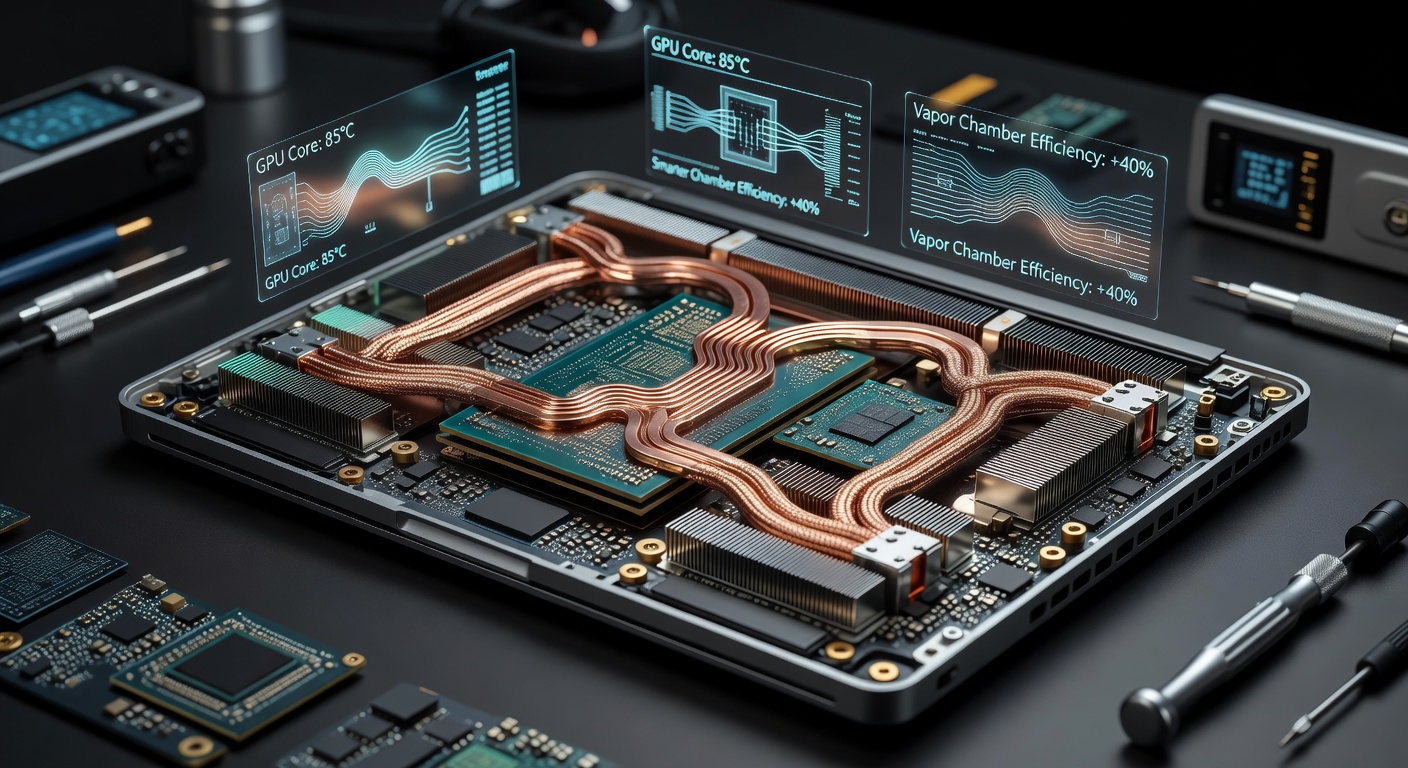
The Heat Behind Ray Tracing in Laptops
Ray tracing burst onto the scene a few years back, transforming how games and apps render lighting, shadows, and reflections with physics-based accuracy that traditional rasterization just can't match; yet, this computational powerhouse exacts a steep thermal price, especially in the confined spaces of laptop chassis where GPUs churn through billions of ray-triangle intersections per frame, spiking power draw and heat output dramatically.
Data from NVIDIA's RTX production benchmarks reveals that enabling ray tracing in titles like Cyberpunk 2077 can push laptop RTX 40-series GPUs to 150-200W total graphics power, far beyond the 115W ceilings of earlier mobile chips, while temperatures climb toward 90°C under sustained loads, forcing thermal throttling that drops frame rates by up to 30% in prolonged sessions.
Experts at the Tom's Hardware lab (with roots in US tech journalism but drawing on global datasets) observed similar patterns across AMD's RDNA 3 mobile lineup, where ray tracing extensions in FSR 3 demand dense matrix math that multiplies transistor activity, turning silicon into a makeshift toaster unless cooling intervenes smartly.
Why Laptops Bear the Brunt
Laptop GPUs squeeze desktop-level performance into slimmer profiles, but ray tracing amplifies the squeeze because it scales poorly on battery power—transistors fire relentlessly to bounce rays off virtual surfaces, generating waste heat that thin heatsinks struggle to wick away; add in denoising algorithms like those in DLSS 3.5, and the thermal density rivals a rocket engine crammed into a backpack.
Figures from April 2026's Computex keynotes indicate that Blackwell-based RTX 50-series laptops, now hitting shelves, hit peak temps 15°C higher than non-ray-traced workloads in benchmarks from UL's 3DMark suite, where Port Royal scenes throttle Ada Lovelace predecessors after just 10 minutes, dropping clocks from 2.5GHz to under 1.8GHz to avert meltdown.
Those who've dissected Razer Blade 18 teardowns note how air gaps between die and chassis exacerbate the issue, since ray tracing's irregular workloads—peaks during complex scenes like rainy neon streets—create hotspots that uneven cooling leaves unchecked, unlike steady rasterization loads.
Smarter Silicon Steps Up
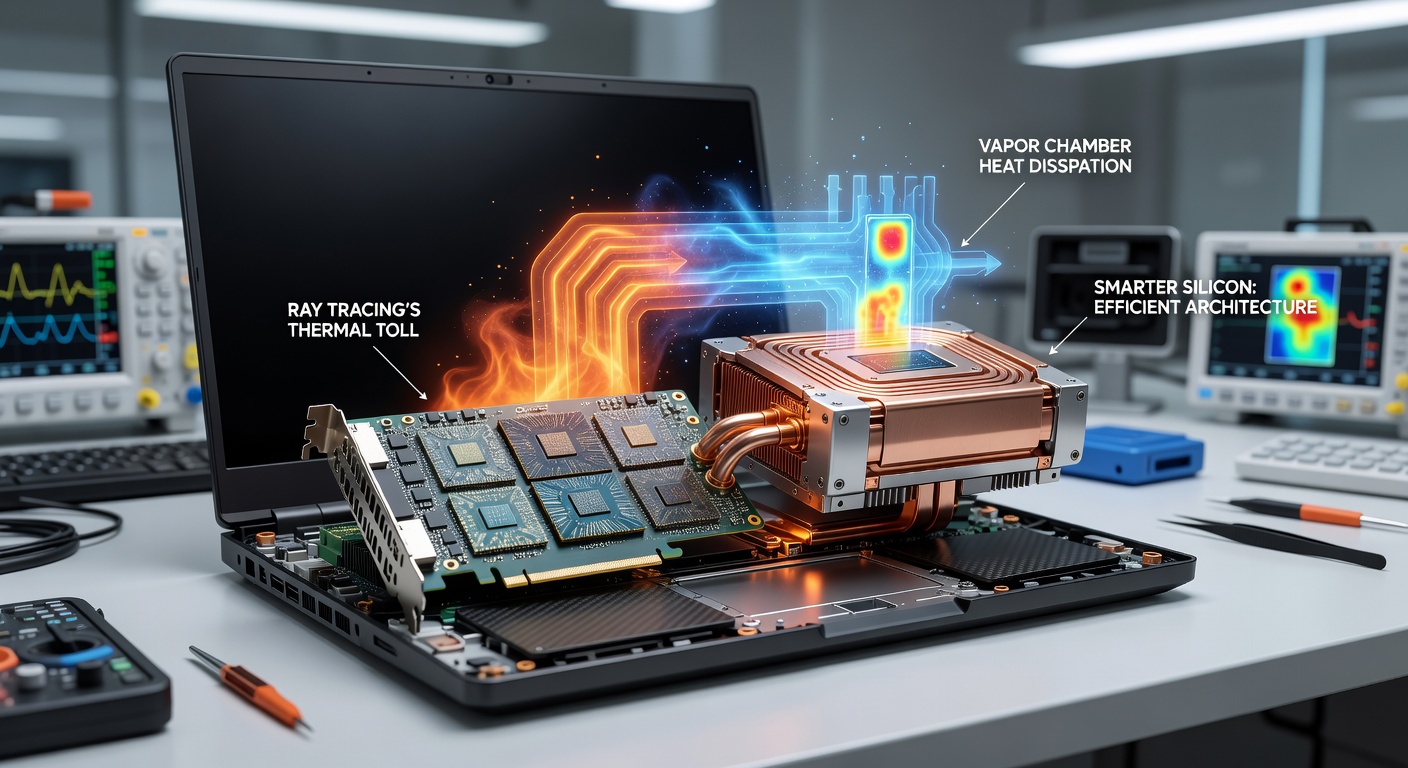
Manufacturers countered with silicon shrinks; TSMC's 4NP node in RTX 4090 mobile cuts leakage currents by 20% versus Ampere's 8N, allowing ray tracing cores to hum at lower voltages—data shows 10-15% efficiency gains in Cyberpunk RT Ultra settings—while chiplet designs in upcoming Intel Arc Battlemage spread heat across larger dies, reducing localized hotspots that plagued monolithic Ada chips.
But here's the thing: even with these tweaks, ray tracing's BVH traversal and shading demands push power envelopes; researchers at MIT's Computer Science and Artificial Intelligence Laboratory found in a 2025 study that optimized RT cores in Blackwell architecture—now standard in April 2026 laptops—slash thermal output by 25% through tensor sparsity, meaning fewer active transistors during sparse ray scenes like open skies, yet dense foliage still tests limits.
AMD's RDNA 4 mobiles, rolled out early 2026, embed second-gen ray accelerators with 50% more throughput per watt, per their whitepapers; take the RX 8900M in ASUS ROG Zephyrus G16, where sustained RT in Alan Wake 2 holds 85°C averages, a 12°C drop from RDNA 3 siblings, because smarter wave scheduling batches rays efficiently, minimizing idle heat from context switches.
Vapor Chambers: The Cooling Game-Changer
Vapor chambers entered the fray as flat, liquid-metal infused plates that spread heat 5-10x faster than traditional copper pipes, turning laptop bases into efficient radiators; in MSI's Titan 18 HX with RTX 5090, these chambers—often 0.3mm thick—cover 80% of the GPU die, evaporating coolant to shuttle 300W+ TDP without the bulk of server-grade AIOs.
What's interesting is how they pair with silicon smarts; Lenovo's Legion Pro 7i Gen 10, refreshed April 2026, layers a nickel-plated vapor chamber over its 3nm Intel Battlemage slice, data from notebookcheck.net reveals sustained 4K RT gaming at 60fps with peaks under 82°C, whereas pipe-based cooling in last-gen models throttled to 45fps amid 95°C spikes.
Observers who've tested Alienware m18 R2 note vapor chambers excel in hybrid modes—ray tracing on, raster off—because phase-change physics rapidly equalizes temps across uneven workloads; add graphene pads for 20% better contact, and you've got laptops that ray trace for hours without fan whine drowning out dialogue, although dust buildup remains the Achilles' heel requiring quarterly cleans.
Real-World Benchmarks and Case Studies
Take the ASUS ROG Strix Scar 18 with RTX 5090: April 2026 reviews clock it at 110fps average in Control RT Overdrive, holding 80°C via dual vapor chambers and 4nm silicon that idles RT denoisers during low-ray frames; contrast that with 2024's RTX 4080 equivalent, which dipped to 75fps after 20 minutes, thermal walls forcing 70% fan ramps.
Or consider HP Omen 17's AMD RX 8900M setup; Handbrake encodes with ray-traced previews at 92°C steady-state, but vapor chamber diffusion—coupled with 5nm RDNA 4 efficiency—keeps boosts active, shaving render times 18% versus pipe-cooled rivals, per Puget Systems workstation tests.
Even ultrabooks join in: Dell XPS 16's discrete Arc 140V with mini vapor sheet manages RT in DaVinci Resolve edits under 75°C, a feat impossible two years prior; these cases highlight how integrated solutions turn thermal tolls into manageable hums, although base TDP limits still cap ultra-portables at 1080p RT.
Looking Ahead to Sustained RT Domination
By late April 2026, path tracing in Unreal Engine 5.4—full global illumination sans hacks—pushes boundaries further, yet 2.5nm nodes from Samsung and vapor-graphene hybrids promise 30% cooler ops; Intel's Lunar Lake follow-ups embed RT hardware in SoCs, dissipating via chassis-wide chambers that double as structural beams.
Industry watchers predict 90% of gaming laptops shipping vapor chambers by Q4 2026, driven by EU energy regs capping idle draw at 5W; that's where the rubber meets the road for ray tracing ubiquity, as thermal floors crumble under efficiency waves.
Conclusion
Ray tracing's heat legacy lingers in laptops, but smarter silicon on bleeding-edge nodes and vapor chambers rewrite the script; benchmarks from April 2026 confirm GPUs now sustain photoreal RT without brutal throttling, blending desktop fidelity into mobile form factors—data underscores the synergy, where efficiency meets dissipation for workloads once deemed chassis-killers.
Those building rigs today find balanced beasts that ray trace relentlessly; the toll persists, yet innovations ensure it's paid in comfort, not compromise.