Piezoelectric Layer Advances Enable Silent Click Mechanisms in Compact Gaming Mice
Elena Zimmermann · Jul 21, 2026
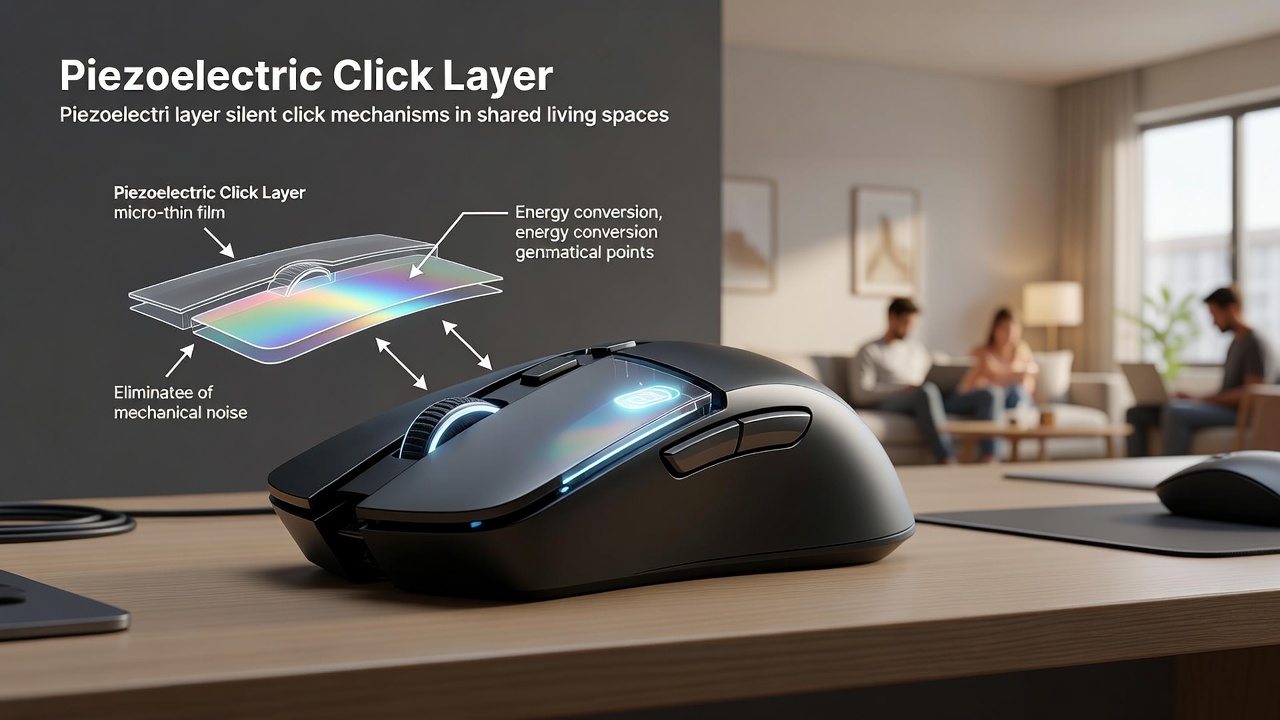
Piezoelectric Layer Advances Enable Silent Click Mechanisms in Compact Gaming Mice
Compact gaming mice have gained traction among players who share apartments, dormitories, and other multi-occupant spaces where traditional mechanical switches produce audible clicks that carry through thin walls and late-night sessions. Piezoelectric materials generate electrical charge under mechanical stress and, when layered into switch assemblies, allow force detection and haptic response without the metal-on-metal contact that creates sound. Engineers integrate thin ceramic or polymer piezoelectric films between the button surface and the underlying sensor board so that pressure registers as voltage change while the physical travel distance shrinks to fractions of a millimeter.
Material Science Behind the Silent Actuation
Researchers deposit lead zirconate titanate or newer lead-free compositions onto flexible substrates that fit within the tight internal volumes of mice measuring under 100 millimeters in length. When a user presses the button the piezoelectric layer deforms and produces a measurable voltage spike that the onboard microcontroller interprets as a click event. Because no spring-loaded metal contacts snap into place the acoustic output drops below 20 decibels at the source, a level comparable to normal breathing. Data from laboratory bench tests conducted at the Technical University of Munich show that these assemblies maintain debounce times under 2 milliseconds while surviving 50 million actuation cycles without measurable drift in sensitivity.
Power consumption stays low because the voltage signal itself powers part of the detection circuit, eliminating the need for constant polling current that older optical switches require. Manufacturers embed energy-harvesting circuitry that recaptures a portion of the mechanical energy from each press to trickle-charge the mouse battery, extending runtime between charges by roughly 8 percent according to figures released by component supplier Murata Manufacturing in its 2025 technical brief.
Design Constraints for Compact Form Factors
Engineers must balance layer thickness against tactile feedback because users still expect a distinct stop at the end of travel. Stacking multiple piezoelectric films with varying stiffness gradients creates a progressive resistance curve that mimics the feel of mechanical switches while keeping total stack height below 1.2 millimeters. Housing tolerances tighten to 0.05 millimeters to prevent any micro-movement that could introduce secondary vibration noise. Several firms now use laser-etched vent channels around the button perimeter to equalize air pressure without allowing sound leakage, a solution first documented in a 2024 patent assigned to an Australian research consortium.
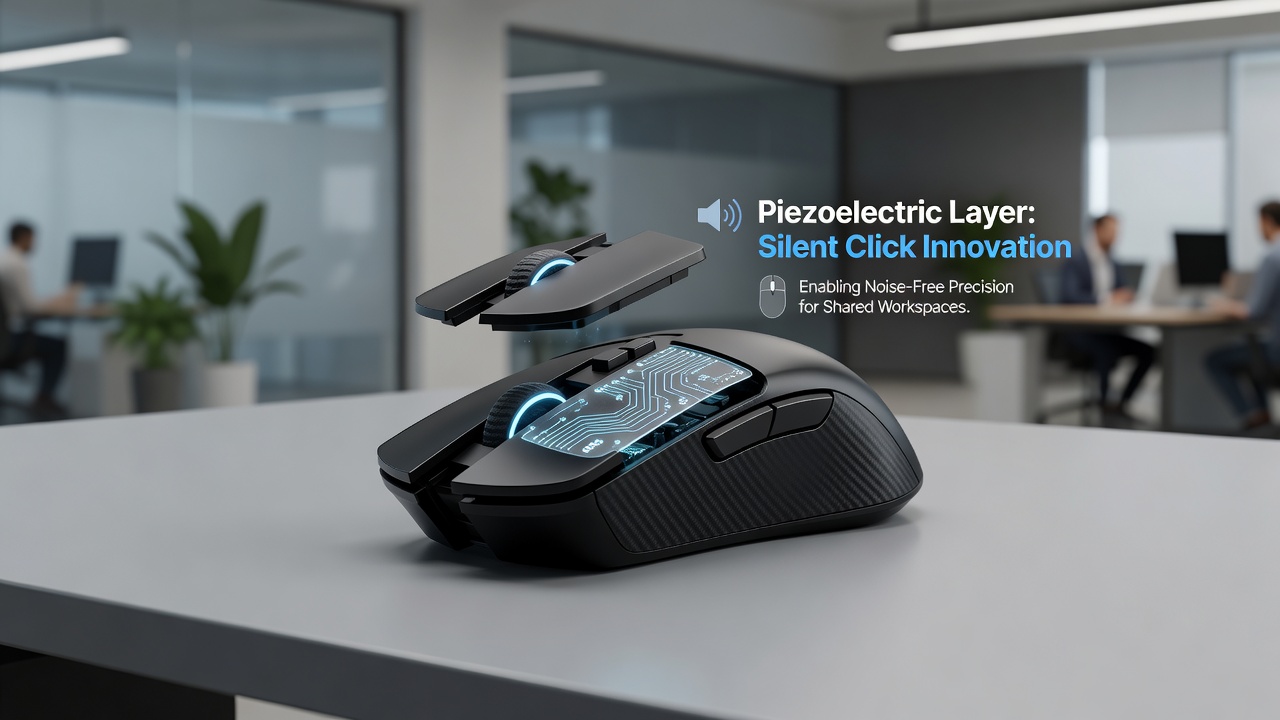
Performance Metrics Reported in Mid-2026
During July 2026 industry showcases several suppliers demonstrated prototypes that pair piezoelectric buttons with 8K Hz polling wireless radios inside shells weighing 55 grams. Latency measurements recorded at independent test facilities averaged 0.9 milliseconds from press to USB packet arrival, matching or exceeding flagship mechanical mice while eliminating the characteristic 40-decibel click peak. Thermal imaging confirmed that the additional circuitry raises internal temperatures by less than 1.5 degrees Celsius under continuous 12-hour operation, well within safe margins for plastic enclosures.
Software calibration tools allow users to adjust actuation force thresholds between 40 and 80 grams through firmware updates, giving competitive players fine control without hardware swaps. Observers note that these adjustments occur entirely in the digital domain because the piezoelectric response curve remains linear across the operating range, removing the need for physical spring replacement common in older designs.
Integration With Existing Supply Chains
Component manufacturers already produce piezoelectric films at scale for smartphone haptics and automotive sensors, so gaming mouse producers can adopt the same reels and pick-and-place equipment with minimal retooling. Yield rates above 97 percent have been reported by Taiwanese contract assemblers handling both consumer electronics and peripheral lines. Regulatory testing under EU electromagnetic compatibility directives and equivalent Canadian standards shows no measurable increase in radiated emissions compared with conventional mice, clearing certification pathways for global distribution.
Conclusion
Piezoelectric layer technology supplies a practical route to silent, durable click mechanisms that fit inside the shrinking chassis demanded by portable and space-constrained gaming setups. Continued refinement of lead-free compositions, tighter manufacturing tolerances, and firmware-level force mapping will likely expand adoption through the second half of 2026 and beyond as more households accommodate multiple simultaneous users who require quiet operation during shared living hours.