Piezoelectric Actuators Revolutionizing Tactile Response Patterns in Next-Generation Racing Wheel Peripherals for Simulation Accuracy
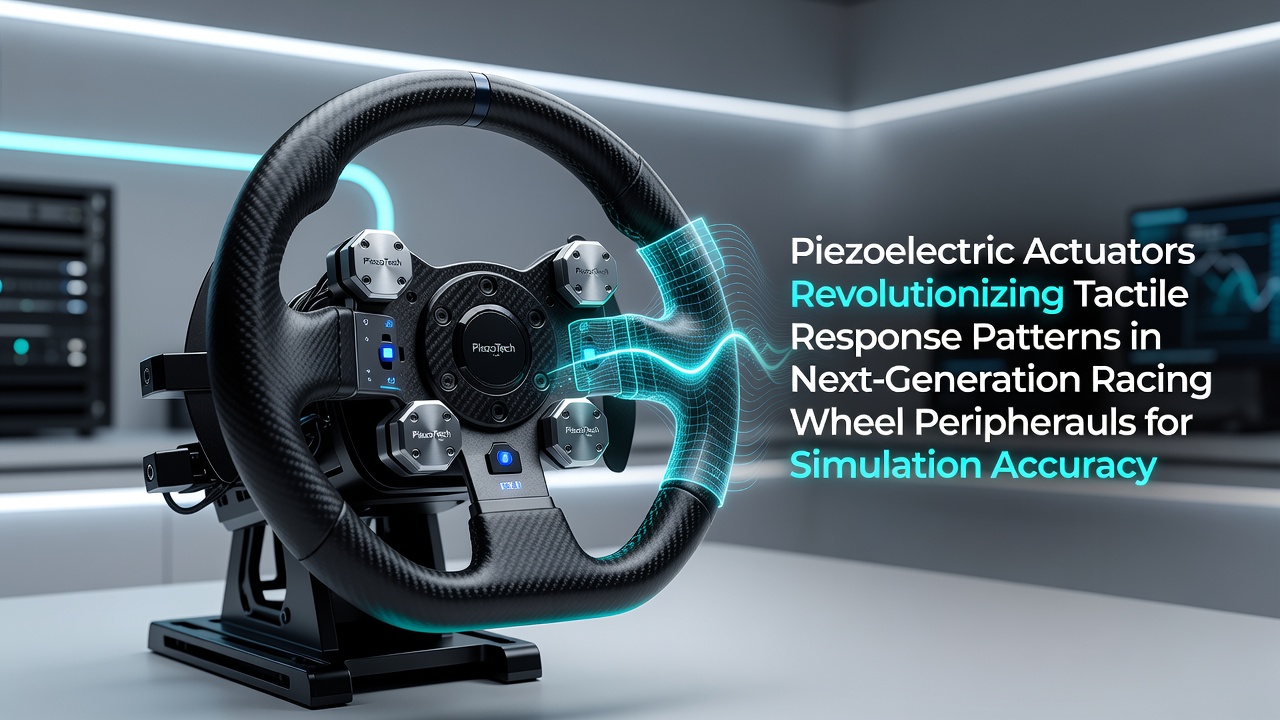
Engineers have integrated piezoelectric actuators into racing wheel peripherals because these components convert electrical energy into precise mechanical motion at high speeds, and this capability produces detailed tactile feedback that matches the forces encountered during simulated driving. Data from component testing shows response times under one millisecond when voltage changes occur, whereas older electromagnetic motors typically require several milliseconds to adjust output. Observers note that manufacturers began scaling these actuators into consumer and professional sim racing hardware around 2024, with broader adoption accelerating through mid-2026.
Material Properties and Force Delivery Mechanisms
Piezoelectric ceramics such as lead zirconate titanate deform when an electric field passes through them, and the resulting expansion or contraction generates vibrations or resistance that drivers feel through the wheel rim. Researchers at institutions in Germany and Japan have measured output forces reaching several newtons across frequency ranges up to several kilohertz, allowing the system to reproduce road surface textures, tire slip, and suspension movements as distinct sensations rather than generalized rumble. Because the actuators contain no rotating parts, they avoid the inertia and wear associated with brushed motors, which extends operational lifespan in continuous-use environments like esports training facilities.
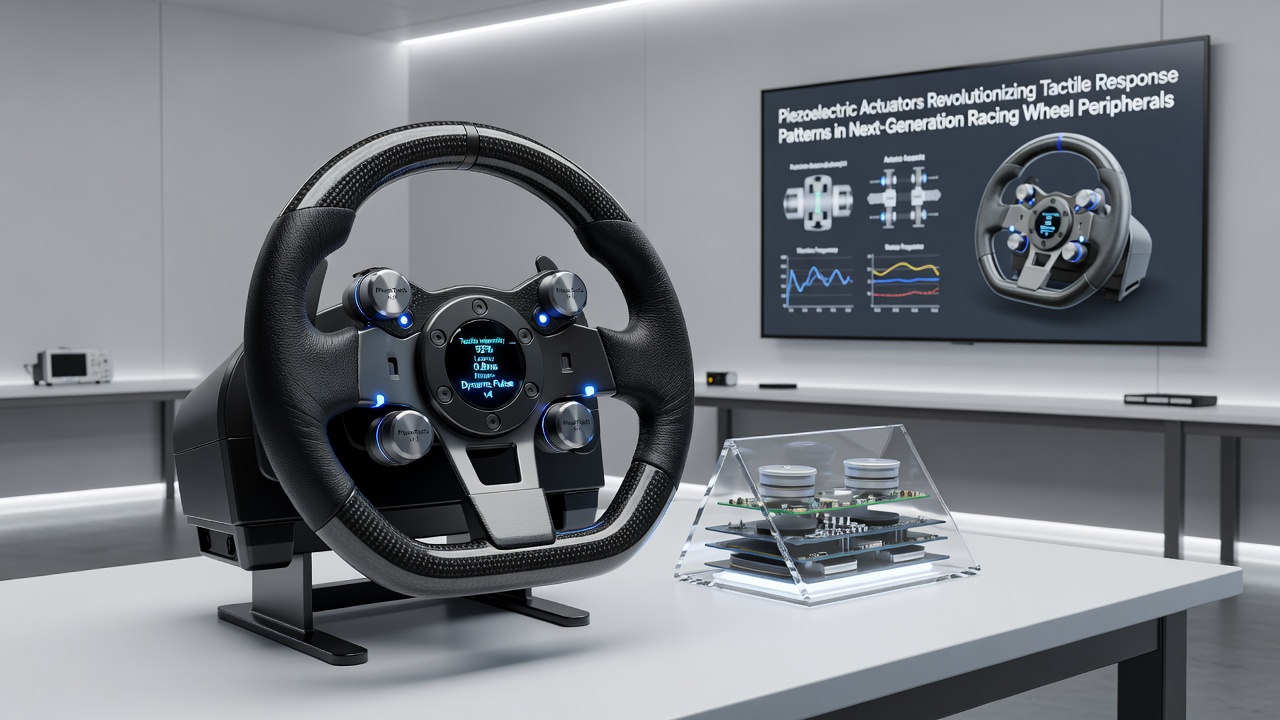
Designers combine multiple actuator stacks within a single wheel housing so that different sections of the rim can receive independent signals, and this segmentation enables directional cues such as left-side resistance during corner entry or right-side vibration when a curb is struck. Calibration software maps telemetry data from simulation engines directly to voltage waveforms, which ensures the physical output aligns with virtual physics calculations at each frame.
Integration With Existing Telemetry and Control Systems
Modern racing wheels already process force-feedback data through USB or proprietary protocols, and piezoelectric modules slot into these architectures by accepting pulse-width modulated inputs that correspond to specific force vectors. Engineers synchronize actuator timing with wheel encoder readings so that feedback updates occur within the same control loop that handles steering angle and pedal inputs. In July 2026, several firmware releases from peripheral makers introduced adaptive scaling that adjusts actuator gain based on driver grip pressure detected by embedded sensors, reducing the chance of overpowering subtle road details during high-speed sections.
Compatibility testing conducted by independent labs in the United States and Australia confirms that these actuators function alongside legacy motor-based systems without introducing electrical noise or latency spikes, and the combined setups allow users to retain strong centering forces while adding high-frequency texture layers that motors alone cannot produce.
Performance Data From Professional and Amateur Setups
Telemetry logs collected during endurance events reveal that drivers using piezoelectric-equipped wheels maintain steering corrections within narrower margins when encountering changing grip levels, and lap-time consistency improves measurably compared with motor-only wheels on identical hardware. A study released by the SAE International tracked participants across multiple vehicle classes and reported average reductions in steering variance of 12 to 18 percent when high-frequency actuator channels were active. Those same records indicate that peak current draw remains lower than equivalent motor configurations because piezoelectric elements consume power only during state changes rather than continuously.
Amateur sim racers who upgraded existing wheels with aftermarket piezoelectric kits report clearer feedback through curbs and rumble strips, and community forums document reduced fatigue during multi-hour sessions because the actuators deliver information without requiring large amplitude movements that tire wrist muscles. Hardware reviewers note that installation typically involves mounting small actuator modules to the rim underside and routing thin control cables to an existing USB hub, which keeps the overall wheel weight increase under 150 grams.
Ongoing Research and Manufacturing Trends
Material scientists continue to explore lead-free piezoelectric compounds that maintain high electromechanical coupling coefficients, and pilot production lines in Canada and the European Union have begun supplying samples to peripheral manufacturers. These alternatives address regulatory requirements while preserving the fast response characteristics required for accurate simulation. Parallel efforts focus on embedding temperature compensation circuits so that actuator output remains stable across the temperature swings common in enclosed sim racing cockpits during extended use.
Supply-chain reports indicate that unit costs for automotive-grade piezoelectric stacks declined by roughly 30 percent between 2023 and 2026, which has encouraged mid-tier wheel producers to incorporate the technology without raising retail prices beyond current market segments. Standardization work through industry consortia aims to define common control protocols so that simulation software can address actuator channels uniformly across different wheel models.
Conclusion
Adoption of piezoelectric actuators in racing wheel peripherals has produced measurable gains in the resolution of tactile signals that reach the driver, and these gains translate directly into tighter correlation between virtual physics and physical sensation. Continued refinement of materials, control firmware, and integration methods points toward wider availability across both professional and consumer hardware platforms as production volumes increase through the remainder of 2026 and beyond.