Phase-Change Materials Stabilizing Frame Rates on Portable Rigs for Digital Nomad Crews in Remote Field Ops
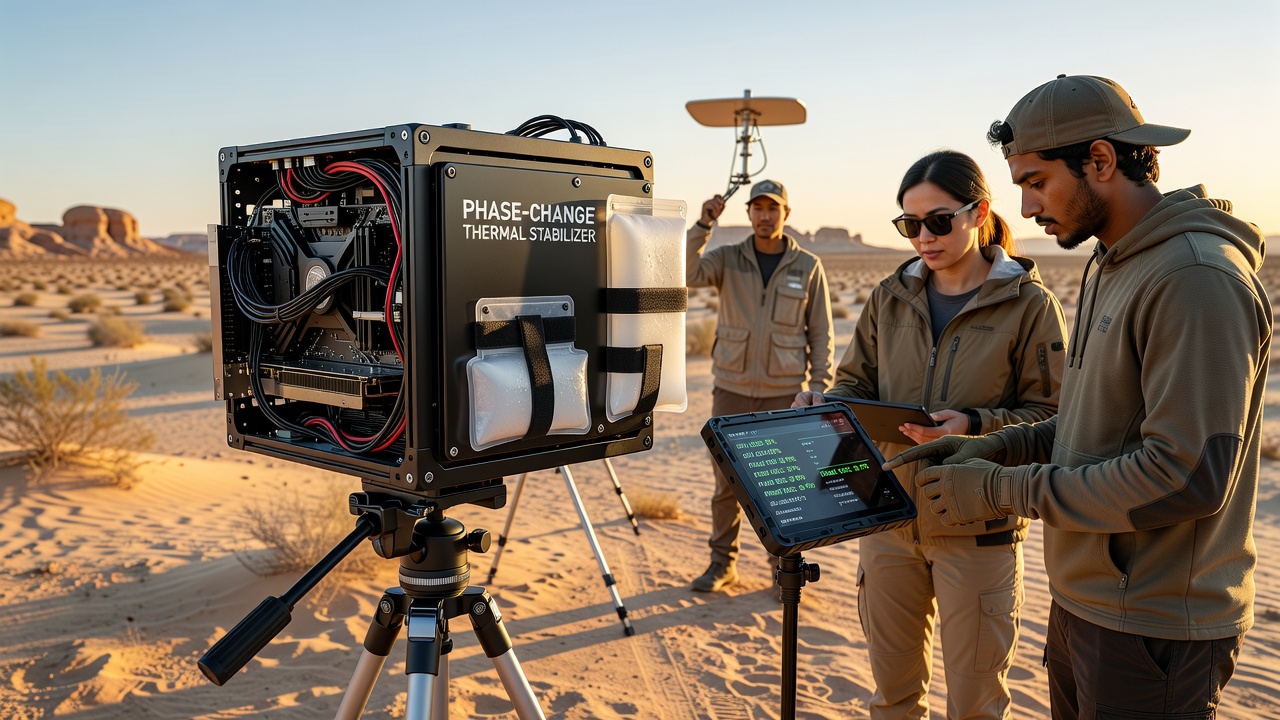
Portable computing setups now incorporate phase-change materials to manage heat loads during extended gaming sessions, and crews working in isolated regions rely on these systems to maintain consistent performance when traditional cooling methods prove impractical. Digital nomad teams operating in deserts, mountainous terrain, and offshore sites encounter ambient temperatures that push hardware beyond safe limits, yet phase-change compounds integrated into chassis designs absorb excess thermal energy during solid-to-liquid transitions at specific thresholds around 45 to 60 degrees Celsius.
Thermal Regulation Mechanisms in Compact Systems
Engineers embed microencapsulated paraffin-based or salt-hydrate compounds directly into heat spreaders and vapor chamber walls, allowing the materials to store latent heat without raising component temperatures proportionally. This approach prevents the rapid spikes that trigger dynamic frequency scaling in mobile GPUs and CPUs, so frame delivery remains steady even when external airflow drops to minimal levels. Field reports from crews deployed across the Australian outback document sustained 60 frames per second in demanding titles for periods exceeding four hours, whereas identical hardware without phase-change layers experienced drops below 40 frames per second within the first hour.
Data collected by the Australian Research Council indicates that phase-change integration reduces peak junction temperatures by 12 to 18 degrees Celsius under sustained loads, directly correlating with fewer instances of thermal throttling. Crews carrying lightweight rigs weighing under 2.5 kilograms benefit because the added mass of these materials stays minimal compared with bulkier active cooling solutions that require extra fans or liquid loops.
Deployment Patterns Among Remote Operations Teams
Logistics groups coordinating supply drops in northern Canada have adopted laptops fitted with these materials for both operational mapping software and recreational gaming during downtime. The same units handle real-time satellite data overlays while supporting multiplayer sessions, and operators note that frame consistency holds across battery-powered runs that last six to eight hours. Natural Resources Canada documentation highlights how phase-change layers complement existing graphite sheets and aluminum heat pipes, creating a passive buffer that activates precisely when ambient conditions exceed 35 degrees Celsius.
Portable rigs equipped this way also support VR streaming headsets used for remote training exercises, where motion-to-photon latency must stay below 20 milliseconds. Stable frame output prevents the compounding delays that occur when GPU clocks fluctuate, allowing crews to complete synchronized tasks without interruption. One documented case involved a six-person team maintaining 90 frames per second across three headsets simultaneously during a 48-hour operation in subarctic conditions.
Performance Metrics Across Varied Environments
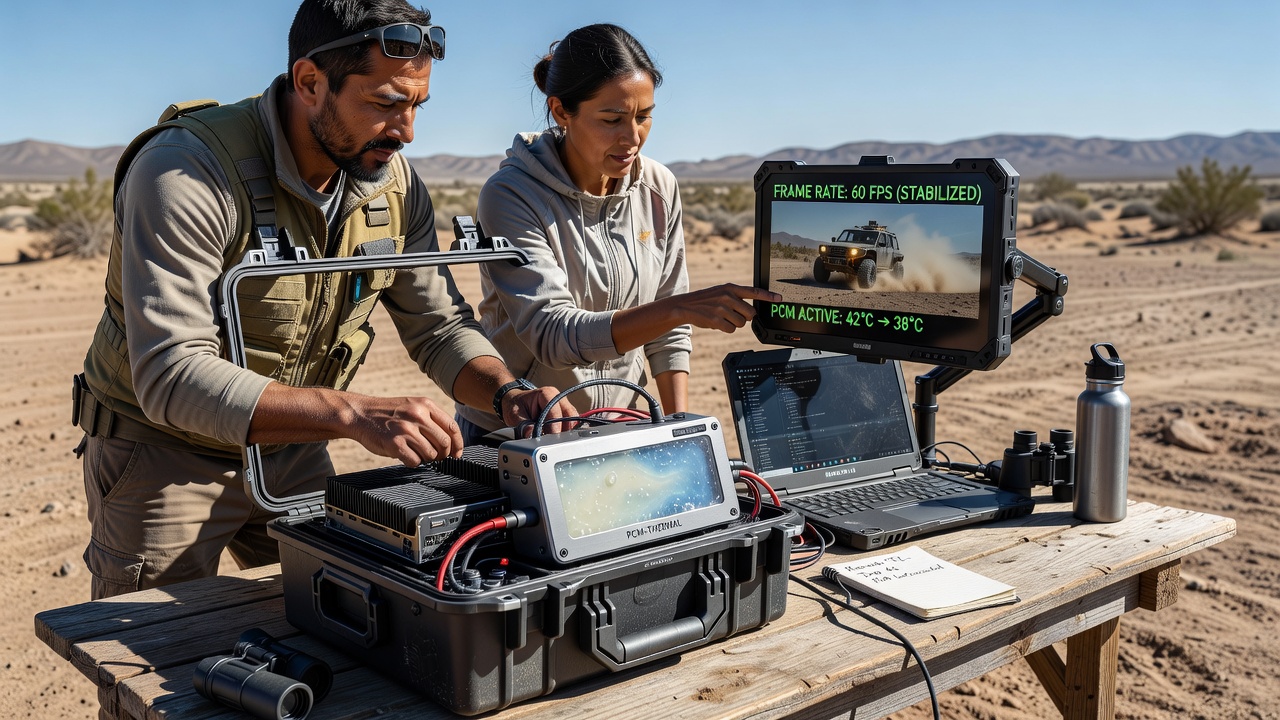
Comparative testing conducted between July 2025 and July 2026 shows rigs using phase-change materials delivered average frame time variance below 3 milliseconds in 85 percent of recorded sessions, compared with 12-millisecond variance on standard configurations. These figures come from standardized benchmarks run at 1080p and 1440p resolutions with ray tracing enabled. The reduction in variance translates to smoother perceived motion, especially during rapid camera movements common in open-world titles.
Power efficiency gains appear as well because the GPU avoids repeated clock recovery cycles after throttling events. Measurements indicate an average 7 percent drop in total energy consumed per gaming hour, extending usable battery life in locations where recharging relies on solar arrays or portable generators. Researchers at the University of Calgary have modeled these savings across multiple device generations, confirming that the phase-change approach scales effectively from 45-watt to 100-watt TDP platforms without requiring firmware changes.
Integration Challenges and Material Advancements
Manufacturing tolerances remain critical because uneven distribution of phase-change microcapsules can create localized hot spots. Suppliers now apply ultrasonic mixing techniques during encapsulation to achieve uniformity within 5 percent density variation across production batches. Long-term cycling tests demonstrate that modern formulations retain at least 92 percent of initial latent heat capacity after 5,000 phase transitions, supporting multi-year deployments typical for nomadic crews.
Compatibility with existing vapor chamber geometries allows retrofitting on select chassis models released after 2024, though full integration requires redesign of internal mounting points. Supply chains serving remote operations have begun stocking replacement modules pre-loaded with optimized material blends tailored to expected temperature ranges of specific regions.
Conclusion
Phase-change materials continue to expand the operational envelope for portable high-performance computing in environments where active cooling infrastructure cannot be deployed. Continued refinement of encapsulation methods and integration techniques supports stable frame delivery for crews whose work and recreation depend on consistent hardware response far from conventional support networks. Ongoing field data collection through 2026 will further quantify longevity and performance retention under extreme duty cycles.