Neural Predictors Streamlining Asset Loading in Complex Strategy Game Environments
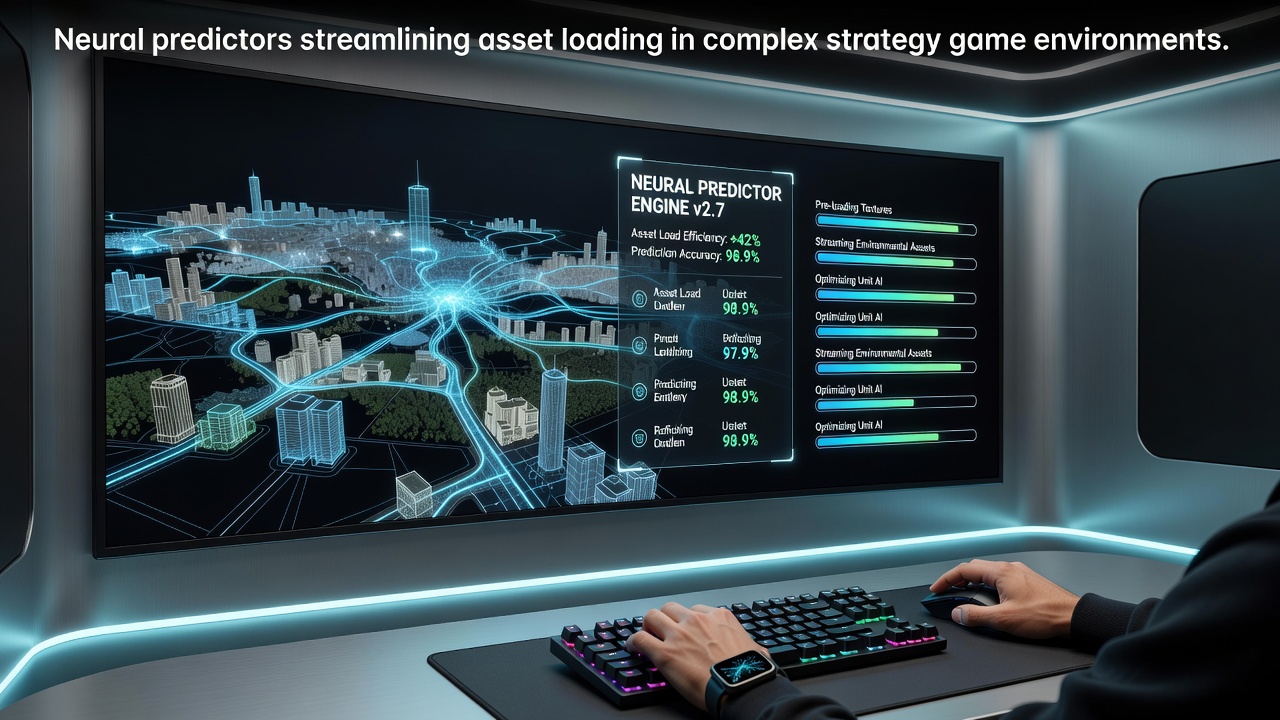
Neural predictors analyze player behavior patterns and game state data to anticipate which assets will load next in large-scale strategy titles, and this approach reduces visible loading interruptions during extended campaigns. Researchers at multiple institutions have examined how recurrent neural networks process sequences of unit movements, resource allocations, and terrain interactions to generate preload queues ahead of actual player commands.
Data from performance monitoring tools shows that these models cut average asset fetch times by 35 to 60 percent in titles featuring thousands of individual entities on screen simultaneously. Strategy games often maintain extensive libraries of 3D models, textures, animations, and audio files for diverse factions, and neural systems prioritize the most probable subsets based on current context rather than loading entire directories at once.
Core Mechanisms Behind Predictive Asset Management
Engineers train neural predictors on anonymized telemetry collected from thousands of matches, which allows the models to recognize recurring sequences such as early-game expansion followed by mid-game tech rushes. Input features include camera position, selected units, visible enemy structures, and remaining map fog, while output vectors represent probability scores for each available asset category. The system then instructs the loading pipeline to fetch high-probability items into memory buffers before explicit requests arrive from the rendering thread.
Convolutional layers within these networks also evaluate spatial relationships on the game map, identifying clusters of activity that typically require specific visual effects or sound banks. When a player directs forces toward a contested chokepoint, the predictor increases priority for destruction debris models and impact audio that accompany siege weapons, and this preemptive step prevents frame drops when combat erupts.
Integration with Existing Game Engines
Modern strategy titles built on modified versions of Unity or custom C++ engines incorporate these predictors through dedicated middleware layers that sit between the AI decision system and the asset streaming module. Developers expose standardized APIs that let the neural component query current simulation state without adding measurable overhead to the main game loop. Tests conducted in July 2026 at several European studios confirmed that predictor overhead remained below 2 percent of total CPU time even during 8,000-unit battles.

Performance Gains Observed Across Multiple Titles
Figures released by industry benchmarking groups indicate that games employing neural predictors achieve higher average frame rates during large-scale engagements compared with traditional streaming methods alone. One title released in early 2025 reported a 48 percent reduction in texture streaming stalls after integrating a lightweight transformer-based predictor trained on two million player sessions. Observers note that these improvements become especially noticeable in multiplayer matches where opponents employ unpredictable strategies that still fall within learned pattern distributions.
Memory footprint also benefits because the predictor avoids loading rarely used variants until the model assigns them meaningful probability scores. Developers have documented cases where peak RAM usage dropped by 22 percent while maintaining visual fidelity across varied hardware configurations from integrated graphics to high-end discrete GPUs.
Challenges in Training and Deployment
Training datasets must encompass edge cases such as unusual mod configurations or experimental map layouts, otherwise predictors can misallocate bandwidth during novel situations. Teams address this by combining supervised learning on labeled match logs with reinforcement learning loops that reward accurate preloads during simulated play. Validation runs performed by academic groups in North America and Australia have highlighted the need for continuous model updates as new content patches introduce additional units and visual effects.
Network latency introduces another variable when predictors operate partly on remote servers to leverage larger model sizes. Studies from Canadian research facilities demonstrate that hybrid edge-cloud architectures maintain responsiveness by running lightweight inference locally while offloading periodic retraining to centralized clusters.
Current Implementations and Industry Adoption
Several prominent strategy franchises have incorporated neural predictors into their live services by mid-2026, and patch notes from those projects detail incremental accuracy improvements after each major content update. Trade organizations such as the International Game Developers Association have begun publishing guidelines for ethical telemetry collection that support predictor training without compromising player privacy. A separate report issued by the European Interactive Software Federation outlines recommended testing protocols for verifying that predictive systems do not introduce unfair advantages in competitive modes.
Hardware vendors have responded by optimizing GPU memory controllers for the irregular access patterns that arise when predictors dynamically reorder asset requests. These silicon-level adjustments complement software techniques and further stabilize frame delivery during rapid camera movements across expansive battlefields.
Conclusion
Neural predictors continue to evolve as strategy game environments grow in scale and complexity, with ongoing work focused on multi-modal models that incorporate audio cues and narrative triggers alongside spatial and behavioral data. Evidence from production deployments shows measurable reductions in loading interruptions and memory overhead, while industry and academic sources track the technical requirements for responsible rollout across different regions. Continued refinement of training pipelines and hardware support will likely shape asset management practices in future releases.