Examining Biodegradable Circuit Boards in Portable Consoles and Their Role in Reducing Electronic Waste During High-Volume Esports Events
Elena Zimmermann · Aug 23, 2026
Examining Biodegradable Circuit Boards in Portable Consoles and Their Role in Reducing Electronic Waste During High-Volume Esports Events
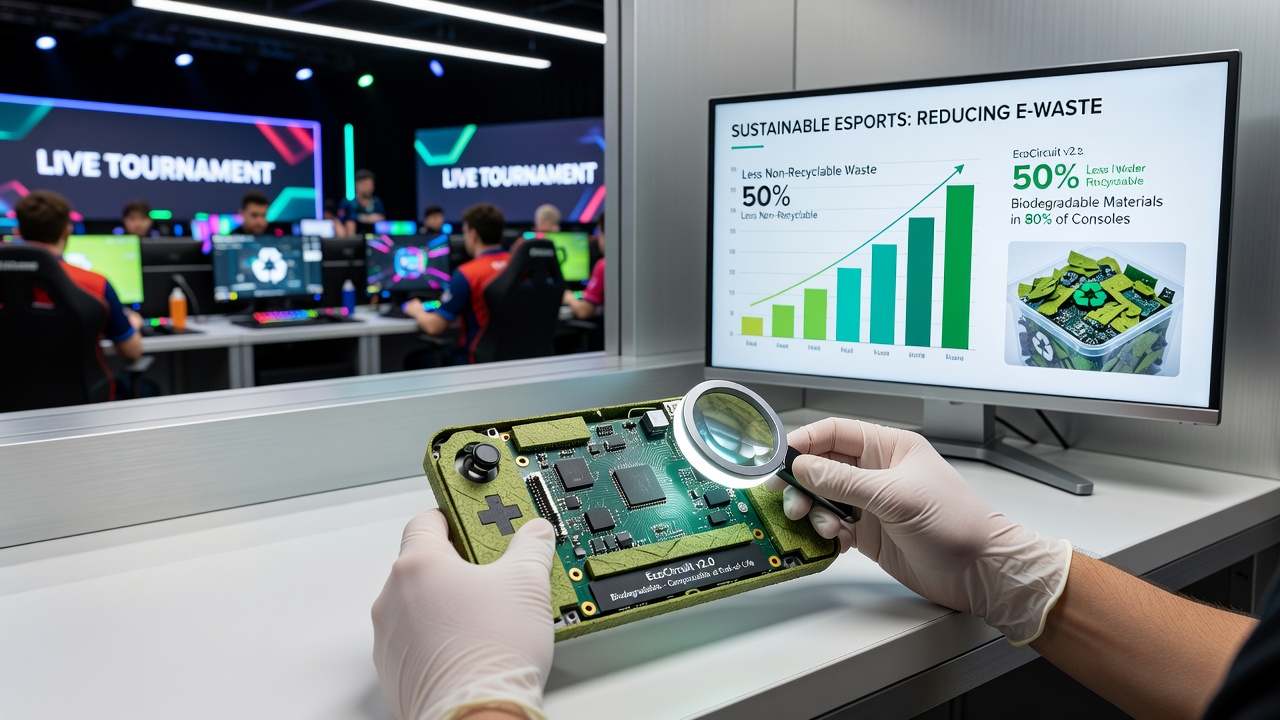
Portable consoles have become central fixtures at major esports tournaments where thousands of devices circulate through player areas, practice zones, and spectator demonstrations each day, and biodegradable circuit boards represent one engineering response to the resulting material disposal challenges. These boards replace traditional fiberglass substrates with plant-derived polymers and conductive inks that break down under controlled composting conditions, which allows manufacturers to address the accumulation of non-recyclable components after events conclude.
Material Composition and Performance Characteristics
Researchers at several university laboratories have developed circuit boards using cellulose acetate and lignin-based resins combined with silver nanowire traces that maintain conductivity while supporting microbial degradation once the boards reach industrial composting facilities. Tests conducted through 2025 demonstrated that these boards retain signal integrity across temperature ranges typical of portable console operation, and they pass standard drop and vibration protocols required for tournament transport. Data from pilot production runs show that the boards achieve comparable thermal dissipation to conventional FR-4 materials when paired with vapor chamber cooling already present in many portable devices.
Electronic Waste Patterns at Large-Scale Esports Gatherings
High-volume events generate concentrated streams of damaged or obsolete hardware because repeated handling, power cycling, and firmware updates accelerate component wear. Tournament organizers report that portable consoles account for a measurable share of the short-life-cycle electronics left behind once competitions end, and landfill diversion rates remain low for mixed-material boards that contain brominated flame retardants. August 2026 schedules include multiple regional finals expected to draw over 50,000 participants and support staff, which creates a predictable spike in post-event disposal volumes that standard recycling streams struggle to process efficiently.
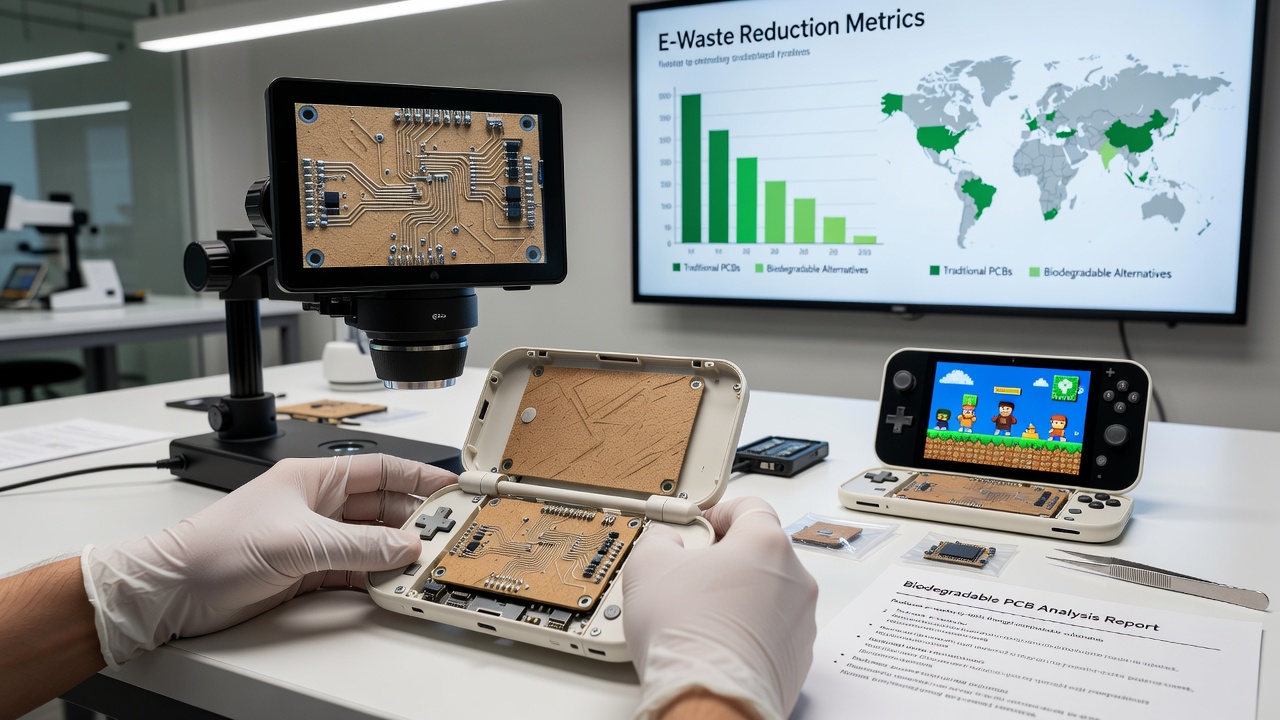
Industry reports compiled by the U.S. Environmental Protection Agency indicate that consumer electronics contribute roughly 2 percent of municipal solid waste in the United States, yet recovery rates for complex assemblies stay below 20 percent. European Union directives have pushed extended producer responsibility programs that assign collection targets to device makers, and similar frameworks are under review in Australia and Canada. These regulatory developments have prompted console manufacturers to explore substrate alternatives that satisfy both performance demands and end-of-life requirements.
Integration into Tournament Hardware Logistics
Manufacturers have begun embedding biodegradable boards into mid-tier portable models used primarily for practice and secondary streaming stations rather than flagship units. Supply chain adjustments include separate labeling so that venue waste teams can route boards directly to certified composting partners instead of mixing them with conventional scrap. One documented case involved a European league that collected 1,200 portable units after a three-day event in 2025, and the biodegradable subset was processed through an agricultural composting facility within eight weeks, yielding measurable reductions in residual mass sent to incineration.
Event planners have also adjusted procurement contracts to require documentation of board composition, which simplifies sorting protocols on-site. Data collected from these pilots show that separation at the point of collection cuts contamination rates in both the compost and metal recovery streams. Observers note that the approach aligns with existing vendor agreements already in place for food-service composting at large venues.
Research Findings on Degradation and Material Recovery
Studies published by teams at the University of British Columbia and collaborating institutions tracked degradation timelines for lignin-based boards under industrial composting conditions and recorded 85 percent mass loss within 120 days. Conductive traces separated cleanly during the process, which allowed silver recovery rates above 90 percent through standard filtration. Parallel trials using conventional boards under identical conditions yielded less than 5 percent degradation, confirming the differential end-of-life behavior. These results have informed certification standards now referenced by several gaming hardware associations.
Scaling Considerations for Future Events
Production capacity for biodegradable boards remains limited compared with established fiberglass lines, yet capacity expansions announced for 2026 target the portable console segment specifically. Cost premiums currently range between 15 and 25 percent, though volume commitments tied to tournament hardware orders have begun to narrow that gap. Supply agreements now under negotiation include provisions for regional composting infrastructure development so that boards used in North American events can be processed locally rather than shipped overseas.
Additional testing focuses on moisture resistance during high-humidity tournament environments and on compatibility with existing battery management systems. Early results suggest that protective coatings applied during assembly preserve board function without impeding later degradation once the coating is removed or breached at end of life.
Conclusion
Biodegradable circuit boards in portable consoles address one segment of the electronic waste stream generated by recurring high-volume esports events. Material performance data, regulatory drivers, and pilot collection programs together illustrate a pathway for reduced landfill contributions when these boards are integrated into tournament logistics and paired with appropriate composting infrastructure. Continued monitoring of degradation rates and recovery yields will determine how widely the approach extends beyond current pilot deployments.