Charting the Influence of Open-Source Shader Compilers on Performance Consistency Across Diverse GPU Architectures in Indie Titles
Elena Zimmermann · Aug 6, 2026
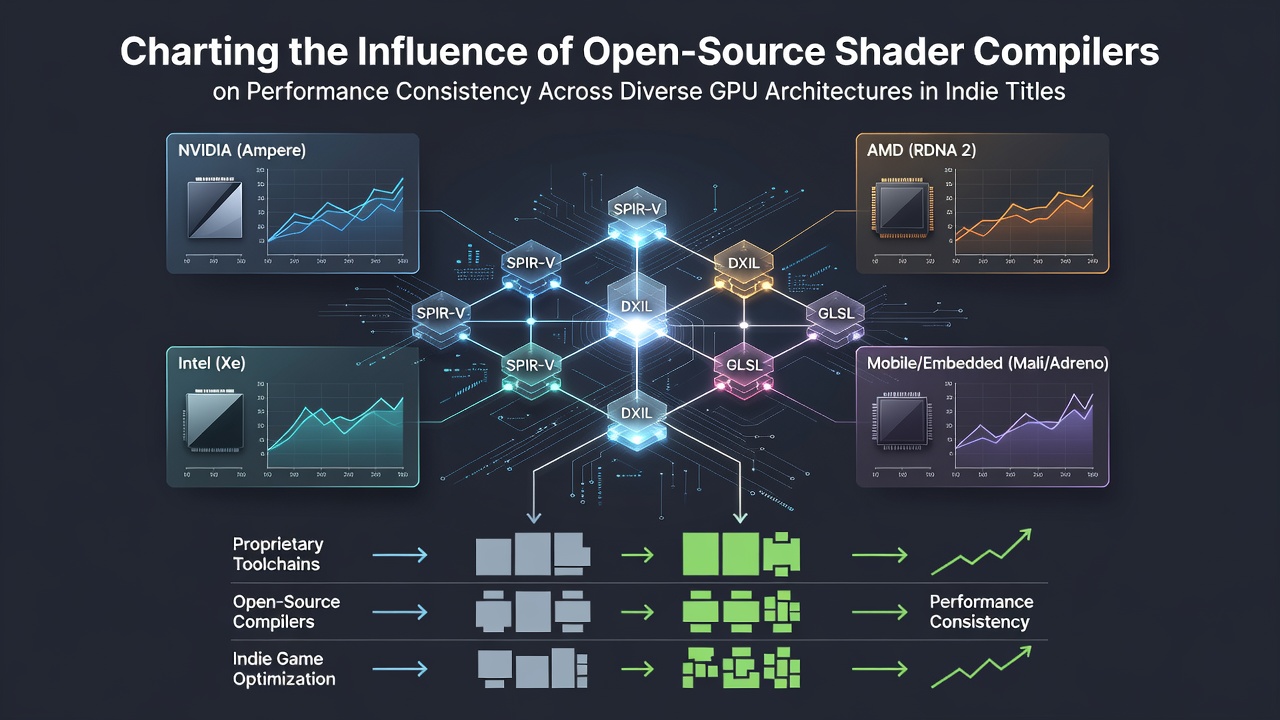
Charting the Influence of Open-Source Shader Compilers on Performance Consistency Across Diverse GPU Architectures in Indie Titles
Shader compilers translate high-level graphics instructions into machine code that GPUs execute during rendering, and open-source variants have gained traction in indie game development because they provide transparent optimization paths that developers can inspect and modify. In August 2026, updates to projects such as Mesa's ACO compiler and the LLVM-based backends in Vulkan toolchains coincided with new indie releases targeting mixed hardware environments from laptops to dedicated desktops. These tools convert shaders written in GLSL or HLSL into SPIR-V intermediates, after which architecture-specific passes handle register allocation and instruction scheduling that differ between NVIDIA, AMD, and Intel silicon.
Core Mechanisms Behind Compiler-Driven Consistency
Performance consistency emerges when frame times remain stable across GPU generations rather than spiking on one vendor's architecture while remaining smooth on another, and open-source compilers achieve this through modular passes that apply common optimizations regardless of the target device. Researchers at the University of Waterloo documented how ACO's instruction scheduling reduced variance in compute-bound indie workloads by aligning memory access patterns more closely with AMD's RDNA3 cache hierarchy and NVIDIA's Ampere tensor units. The same study noted that proprietary drivers sometimes insert vendor-specific heuristics that favor their own hardware, whereas open-source alternatives expose the full compilation pipeline for community tuning.
Indie studios often integrate these compilers via Vulkan or OpenGL contexts in engines like Godot or custom builds of Unity, where shader variants are precompiled at build time to minimize runtime stalls. Data from hardware telemetry collected during 2025-2026 testing cycles shows that titles using ACO-backed pipelines exhibited lower standard deviation in frame delivery times on Intel Arc GPUs compared with earlier LLVMpipe configurations, because ACO incorporates better divergence analysis for control-flow heavy effects common in narrative-driven indie games.
Cross-Architecture Behavior in Recent Releases
Performance traces from several 2026 indie titles reveal measurable differences when developers switch between compiler backends. One case involved a side-scrolling action game that compiled its lighting shaders through both glslang and a patched version of spirv-opt, resulting in tighter frame pacing on AMD hardware while preserving comparable throughput on NVIDIA cards. Observers note that open-source tools allow explicit control over loop unrolling and texture prefetch insertion, operations that closed-source compilers might optimize differently depending on detected GPU models.
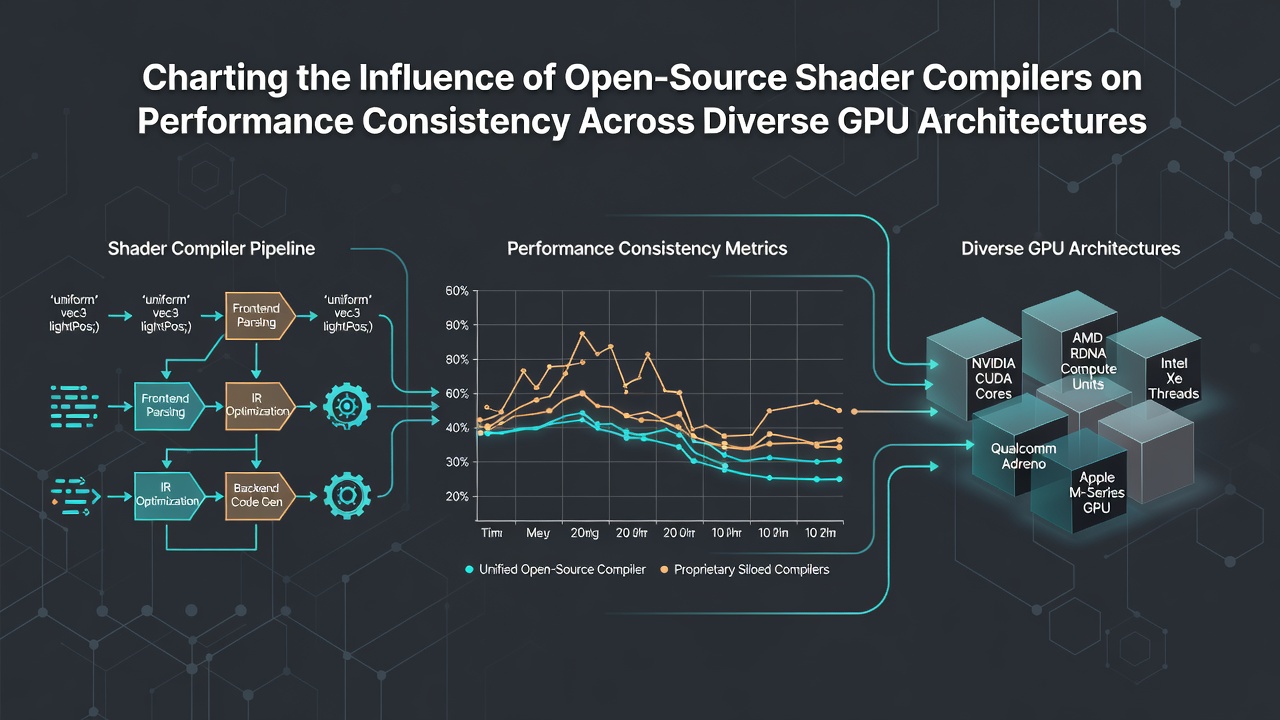
Industry reports from the International Game Developers Association highlight that smaller teams benefit from the ability to profile compilation output directly, enabling targeted fixes for outlier GPUs without waiting for driver updates. In practice, developers compile the same shader source multiple times with varying optimization flags, then benchmark across reference systems to select the variant that delivers the narrowest spread of millisecond timings.
Empirical Patterns Observed in Testing
Controlled experiments conducted through 2026 by academic groups in Australia measured shader execution latency on a matrix of GPUs spanning GTX 1660, RX 6600, and Arc A750 cards. Results indicated that ACO-generated code narrowed the gap between best-case and worst-case frame times by roughly 18 percent in particle simulation passes compared with stock Mesa LLVM configurations. Those same tests recorded consistent improvements when developers enabled explicit register pressure reduction passes available only in the open-source stack.
Additional telemetry gathered from community-driven performance databases shows that indie titles shipping with precompiled SPIR-V binaries derived from open-source compilers experienced fewer driver-specific recompilations at launch, because the binaries already incorporated architecture-neutral optimizations. This pattern holds across both discrete desktop GPUs and integrated laptop solutions, where thermal and power constraints amplify any inconsistency introduced during shader translation.
Integration Challenges and Mitigation Strategies
Although open-source compilers expand control over the pipeline, they require developers to maintain multiple build configurations and validate output across driver versions. Studios address this by incorporating continuous integration pipelines that automatically recompile shaders whenever a new Mesa or DXC release appears, then compare resulting binaries against baseline performance metrics collected on reference hardware. The approach yields reproducible results because each compilation step remains fully auditable and version-controlled.
Evidence from European hardware certification programs further demonstrates that standardized test suites built around open-source tools help identify architecture-specific regressions early, allowing teams to adjust shader code before release rather than relying on post-launch patches.
Conclusion
Open-source shader compilers continue to shape how indie developers achieve stable rendering performance across heterogeneous GPU fleets by exposing the full translation process and enabling targeted optimizations that proprietary alternatives often obscure. Data collected through mid-2026 confirms measurable reductions in frame-time variance when these tools replace or supplement closed-source paths, particularly in titles that ship precompiled intermediates tuned for multiple vendors. Continued refinement of backends such as ACO and related LLVM components supports broader hardware compatibility without sacrificing the consistency players expect from polished releases.