Charting Synchronization Protocols Between Multiple Monitors in Immersive Sim Racing Setups for Professional Drivers
Mara Baumann · Jun 9, 2026
Charting Synchronization Protocols Between Multiple Monitors in Immersive Sim Racing Setups for Professional Drivers
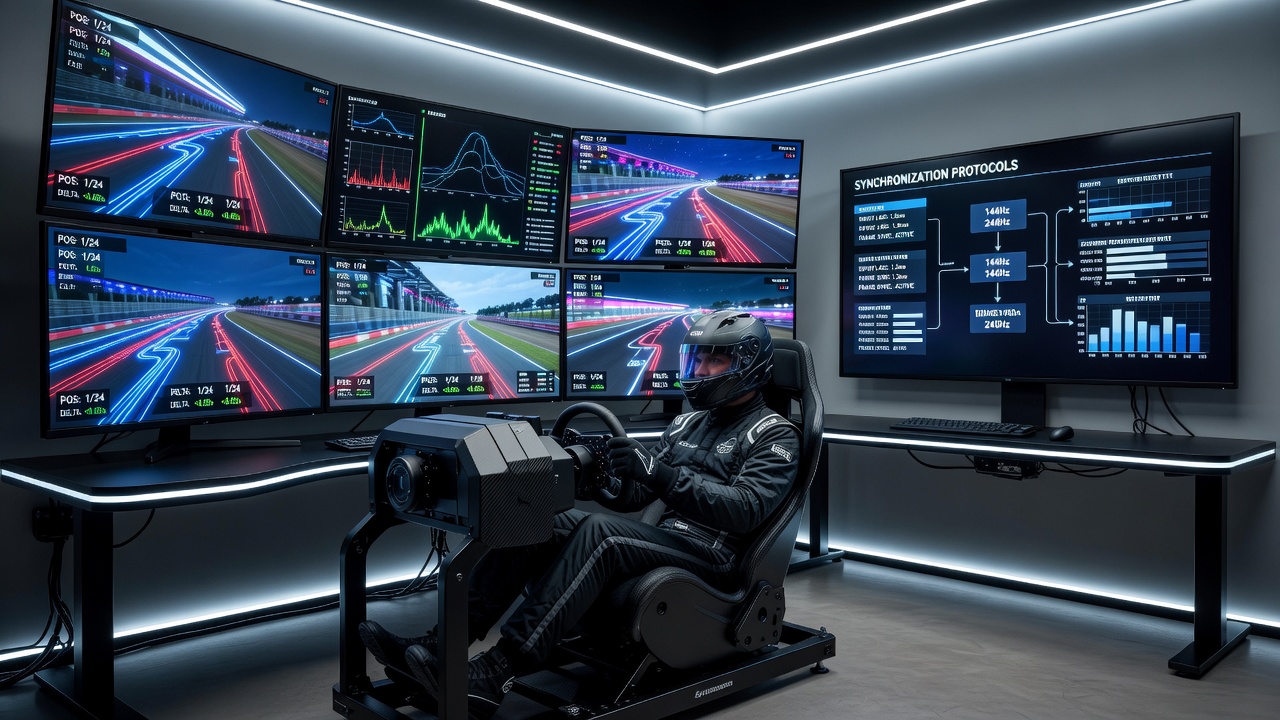
Professional drivers rely on multi-monitor configurations to achieve the peripheral vision and spatial awareness that mirror real track conditions, and synchronization protocols ensure that images align without tearing or delay across displays. These systems combine hardware interfaces with software corrections to maintain consistent frame delivery, which matters when lap times hinge on split-second visual cues. Observers note that setups typically involve three or more panels arranged in a curved array, each running at matching refresh rates while the rendering pipeline distributes frames through a central GPU cluster. Protocols handle bezel compensation by shifting rendered content to account for physical gaps, and they enforce genlock signals so that vertical blanking intervals coincide across every screen. Data from industry reports indicates that mismatches as small as one millisecond can disrupt depth perception during high-speed cornering sequences.Core Technologies Driving Display Alignment
Engineers have developed several approaches that address the demands of immersive racing rigs. NVIDIA Surround and AMD Eyefinity extend a single desktop across multiple outputs while applying edge blending algorithms, yet professional installations often layer additional tools on top to achieve tighter timing. Research published through IEEE conferences shows that custom firmware extensions can reduce inter-monitor skew to sub-frame levels by embedding timestamp packets directly into the display stream.
Variable refresh rate extensions such as G-Sync and FreeSync have expanded into multi-display mode, allowing each panel to adapt independently while a master controller reconciles the overall cadence. Those who maintain pro-level rigs report that combining these adaptive features with dedicated sync boxes produces stable operation even when individual monitors run at 240 Hz. The result appears in consistent motion across the entire field of view, which supports accurate judgment of braking points and apex trajectories.
Integration With Motion Platforms and Telemetry
Sim racing environments rarely stop at visuals alone. Motion actuators, force feedback wheels, and real-time telemetry overlays must remain phase-locked with the rendered frames. Protocols therefore incorporate auxiliary channels that carry positional data alongside pixel streams, ensuring that a sudden steering input registers visually at the same instant the seat shifts. Studies conducted at technical institutes in Germany demonstrate that such unified timing reduces reported disorientation during extended sessions.
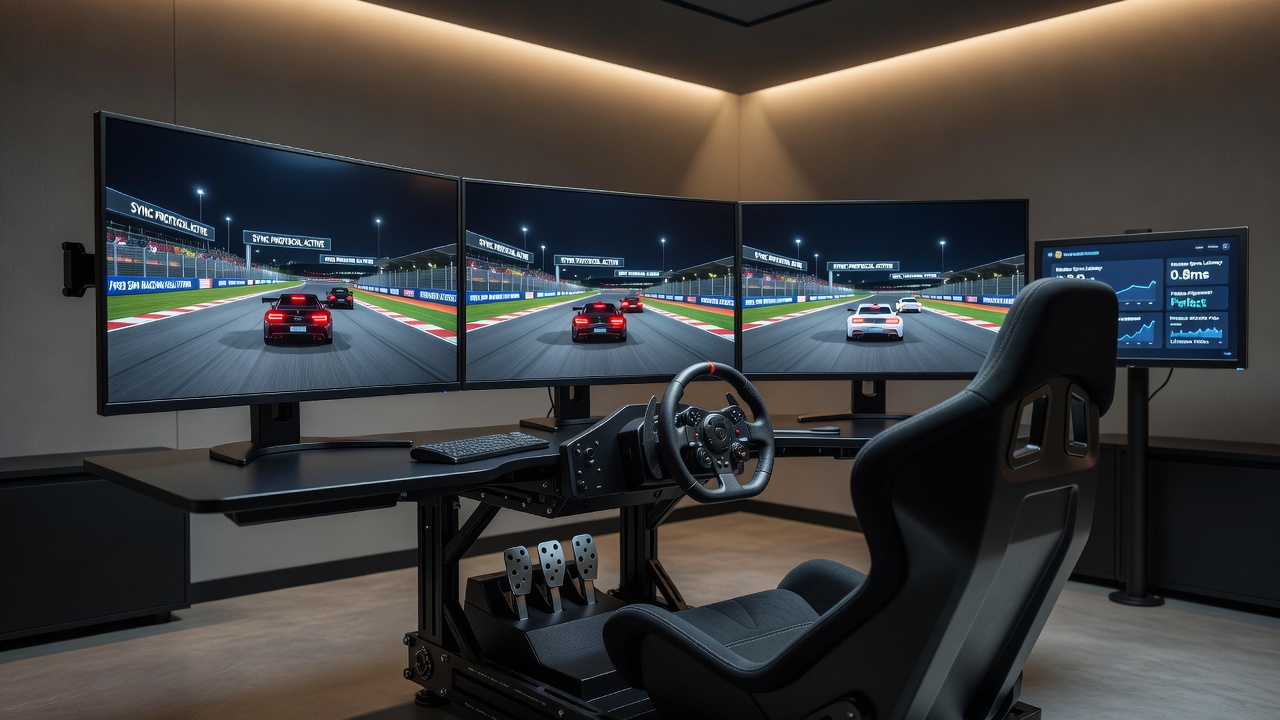
June 2026 has seen wider adoption of 8K-capable interfaces that bundle synchronization metadata within the same cable run, reducing the need for separate genlock wiring looms. Teams working with these newer standards note fewer calibration cycles between practice runs, since automatic detection routines can verify alignment on every system startup. The approach also accommodates mixed-vendor monitor arrays, which previously required manual offset tables maintained by support staff.
Calibration Workflows Used by Professional Teams
Calibration begins with pattern generators that project grid lines across all screens simultaneously, allowing software to measure pixel offsets at the bezels. Technicians then apply fractional adjustments to both horizontal and vertical scan parameters until the lines appear continuous. Once basic geometry is locked, latency probes cycle test patterns at varying frame rates to confirm that each monitor responds within the same temporal window. Figures released by simulation hardware manufacturers indicate that teams following this sequence achieve repeatability within 0.2 milliseconds across sessions.
Those maintaining driver-specific rigs often store multiple profiles that account for different track types or lighting conditions in the physical space. A profile tuned for an indoor facility with controlled ambient light may differ from one used at an outdoor exhibition where reflections alter perceived contrast. Automated scripts reload the correct set of offsets when the system detects changes in monitor serial numbers or firmware revisions.
Emerging Standards and Compatibility Testing
Industry groups continue to refine open specifications that allow third-party developers to implement synchronization without proprietary lock-in. One initiative coordinated through European research networks focuses on timestamp embedding compatible with both HDMI 2.1 and DisplayPort 2.0 transports. Early validation tests conducted in partnership with racing simulation studios show that these methods maintain frame coherence even when one display temporarily drops to a lower refresh rate during thermal throttling events.
Compatibility matrices published by hardware review organizations list which GPU driver versions support multi-monitor variable refresh without introducing additional latency. Professional crews consult these matrices before upgrading components, because a single mismatched driver can offset an entire array by several frames until a rollback restores timing.
Conclusion
Synchronization protocols continue to evolve alongside display hardware and rendering engines, giving professional drivers access to wider fields of view without sacrificing temporal precision. As interfaces mature and calibration tools become more automated, the overhead required to maintain aligned multi-monitor arrays decreases, allowing teams to focus resources on driver training and vehicle setup rather than display troubleshooting. The underlying requirement remains unchanged: every pixel across every screen must update in lockstep so that visual information reaches the driver at the exact moment physical forces act on the chassis.