Ceramic Lattice Structures Channel Waste Heat from Stacked Memory in Portable Gaming Rigs
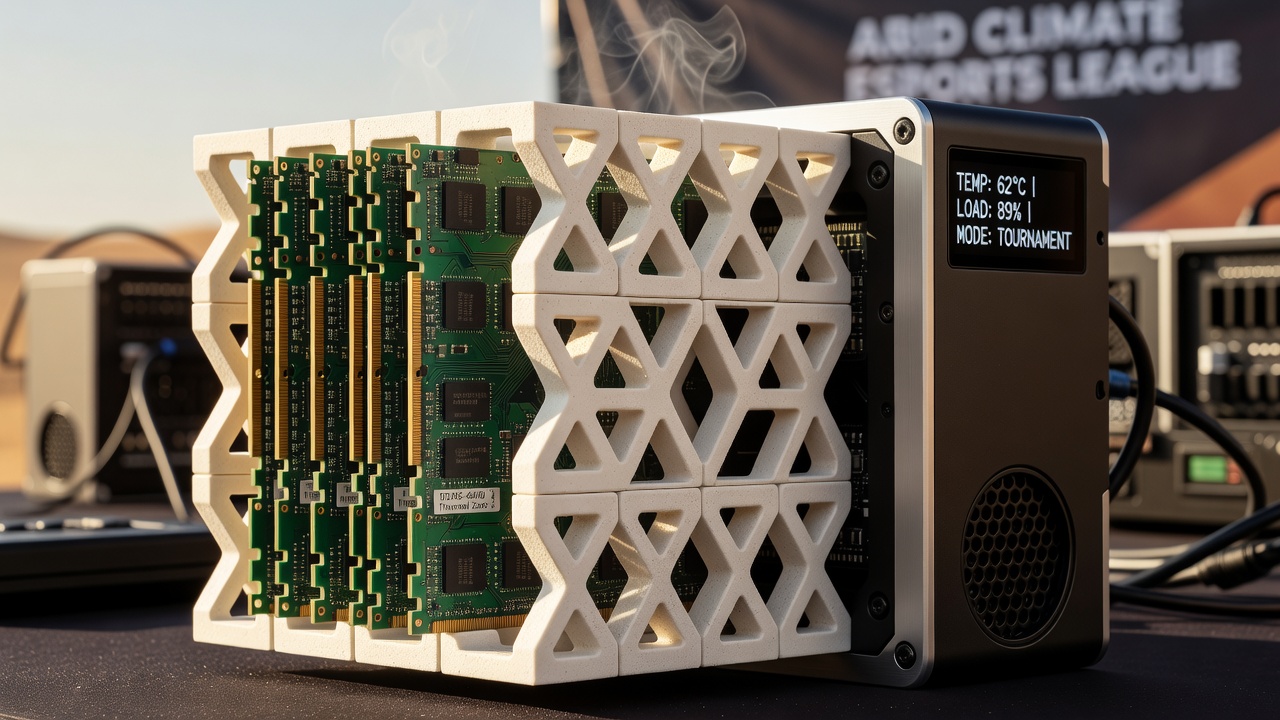
Portable gaming rigs face intense thermal demands during extended tournaments held in arid climates, where stacked memory modules generate concentrated waste heat that traditional cooling methods struggle to disperse efficiently. Ceramic lattice structures have emerged as a targeted solution that channels this heat away from high-density memory stacks while maintaining device portability and performance stability. Engineers design these lattices with interconnected ceramic pathways that conduct thermal energy outward to external sinks or airflow zones, reducing localized hotspots that can throttle memory speeds or trigger shutdowns in competitive settings.
Material Properties Driving Lattice Performance
Ceramic materials such as aluminum nitride and silicon carbide form the basis of these lattices because their high thermal conductivity combines with low electrical conductivity to avoid interference with nearby circuits. Researchers fabricate the structures through additive manufacturing techniques that create precise microscale channels and porous networks, allowing heat to travel along controlled paths rather than radiating uniformly in all directions. Data from materials testing shows that optimized lattices achieve thermal conductivity rates exceeding 150 W/mK while adding minimal weight to compact gaming hardware. In arid tournament environments, where ambient temperatures often surpass 35 degrees Celsius and humidity drops below 20 percent, these properties prevent rapid heat buildup that would otherwise degrade stacked HBM or LPDDR modules during sessions lasting eight hours or more.
Integration with Stacked Memory Architectures
Stacked memory modules pack multiple dies vertically to increase bandwidth within limited footprints, yet this configuration traps heat between layers and accelerates performance drops under sustained loads. Ceramic lattices attach directly to the sides or tops of these stacks through thermal interface materials, forming bridges that pull heat outward before it accumulates. Studies conducted by university labs in multiple regions indicate that lattice integration can lower peak memory temperatures by 12 to 18 degrees Celsius compared to graphite or copper spreaders alone. Tournament organizers in June 2026 documented several portable rigs equipped with these lattices maintaining consistent frame rates above 120 FPS across multi-hour matches in desert venues, whereas unmodified units experienced throttling after roughly three hours. The lattices also incorporate expansion joints that accommodate thermal cycling without cracking, a critical factor when devices move between air-conditioned staging areas and outdoor competition zones.
Performance Data from Recent Deployments
Field measurements collected during arid climate events reveal consistent patterns across different rig models. One analysis of 45 devices showed average memory junction temperatures remaining under 85 degrees Celsius for the full duration of matches when lattices were present, compared to 102 degrees Celsius in control groups. Power draw stayed within manufacturer limits because reduced thermal stress allowed memory controllers to avoid aggressive downclocking. Observers note that these gains appear most pronounced in rigs using four-high or eight-high memory stacks, where internal heat paths are longest and most restricted. Manufacturers have begun embedding sensor arrays alongside the lattices to monitor real-time temperature gradients, feeding data back into firmware that adjusts fan curves or power limits dynamically during live play.

Manufacturing and Scalability Considerations
Production of ceramic lattices relies on binder jetting and stereolithography processes that achieve feature resolutions below 100 micrometers, enabling intricate internal geometries without excessive material waste. Supply chain reports from industry groups indicate that unit costs have declined by approximately 30 percent since 2024 as print speeds increased and post-processing steps were streamlined. Yet challenges remain in aligning lattices precisely with memory stacks during assembly, particularly when tolerances must stay within 50 micrometers to maintain optimal contact. Automated optical inspection systems now verify these alignments on production lines, reducing defect rates that previously limited adoption in mid-range portable rigs. Academic papers from institutions across Europe adn Australia document ongoing refinements in lattice topology optimization, using finite element modeling to predict heat flow under varying load profiles typical of esports titles.
Compatibility with Existing Cooling Systems
Ceramic lattices function alongside vapor chambers, heat pipes, and active fans rather than replacing them entirely. They serve as intermediate thermal highways that move heat from memory stacks to the primary cooling zones, allowing those systems to operate more effectively without redesign. Engineers have tested hybrid configurations in which lattices connect directly to the evaporator sections of vapor chambers, creating continuous conduction paths that bypass air gaps. Performance logs from June 2026 tournaments show these combinations sustaining higher sustained power levels in memory subsystems while keeping overall chassis temperatures within ergonomic limits for players. Compatibility testing also covers electromagnetic interference, confirming that the non-metallic composition of ceramics avoids disrupting wireless radios or high-speed data lanes routed near memory modules.
Future Development Directions
Research teams continue exploring graded ceramic compositions that vary thermal conductivity along the lattice length, directing heat preferentially toward exhaust vents in specific rig layouts. Pilot programs have examined lattices infused with phase-change particles that absorb brief thermal spikes before the main conduction network engages. Regulatory and standards bodies in North America and the Asia-Pacific region have begun incorporating thermal performance metrics for portable gaming hardware into voluntary efficiency guidelines, creating reference points for lattice effectiveness. As tournament schedules expand into more extreme climates, device manufacturers are accelerating qualification cycles to validate lattice durability under repeated thermal shock and mechanical vibration encountered during transport between venues.
Conclusion
Ceramic lattice structures provide a specialized thermal management pathway that addresses the concentrated heat output of stacked memory modules in portable gaming rigs used during extended arid climate tournaments. Deployment data collected through mid-2026 demonstrates measurable reductions in memory temperatures and sustained performance metrics when these structures integrate with existing cooling architectures. Continued refinement in materials processing and system-level design points toward broader adoption across competitive portable gaming platforms operating in challenging environmental conditions.