Bio-Inspired Algorithms Enhancing Pathfinding in Open-World Survival Simulations

Survival titles with expansive open environments demand pathfinding systems that adapt to dynamic terrain, resource shifts, and unpredictable obstacles, and researchers have turned to bio-inspired algorithms to meet those demands. These methods draw from natural processes such as ant foraging trails, bird flocking patterns, and evolutionary selection pressures, allowing virtual agents to compute efficient routes across large maps without exhaustive computation at every step. Data from game engine benchmarks shows that ant colony optimization variants reduce average path recalculation times by up to 40 percent compared with traditional A* implementations when maps exceed 10 square kilometers.
Core Mechanisms Behind Nature-Mimicking Search Routines
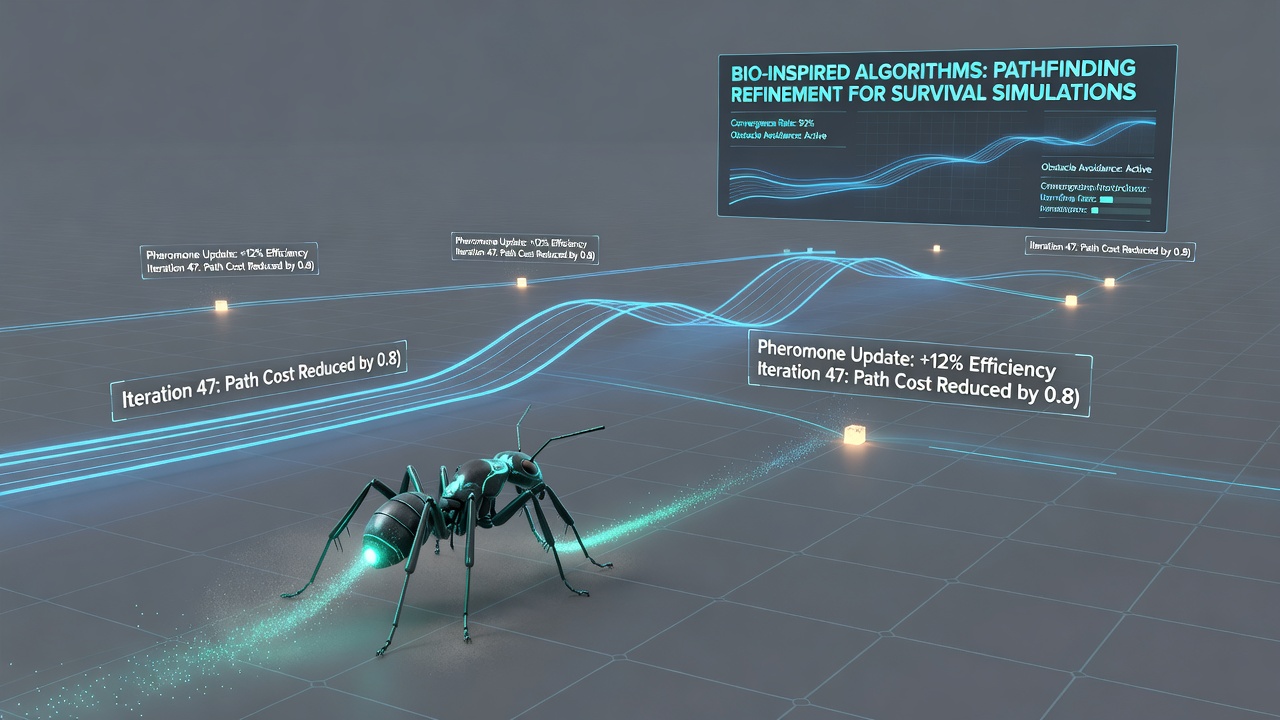
Ant colony optimization replicates pheromone deposition and evaporation, where virtual agents leave digital markers that strengthen promising routes while fading weaker ones over simulated time cycles. Particle swarm optimization meanwhile treats each candidate path as an individual particle that adjusts velocity based on both personal best and global best positions discovered by the swarm. Genetic algorithms introduce crossover and mutation operators that recombine successful path segments from prior generations, producing hybrid routes suited to changing conditions such as seasonal flooding or newly spawned structures. Studies published by the Australian Centre for Intelligent Systems indicate that hybrid implementations combining swarm and genetic approaches achieve convergence rates 25 percent faster than single-method baselines in procedurally generated biomes.
Integration with Survival Game Architectures
Engineers integrate these algorithms into navigation meshes that update in real time as players alter the landscape through construction, destruction, or resource harvesting. In titles featuring persistent worlds, pathfinding agents query pheromone maps only when environmental changes exceed predefined thresholds, which conserves CPU cycles during extended play sessions. Figures from the European Game Technology Consortium reveal that studios adopting bio-inspired layers report a 30 percent drop in AI-related frame drops when more than 200 non-player characters navigate simultaneously across open terrain. Developers schedule incremental map updates during low-activity windows, allowing pheromone evaporation rates to align with in-game day-night cycles and weather events.
Performance Gains Documented in July 2026 Industry Reports
Presentations at the July 2026 International Simulation Technology Symposium highlighted field tests where bio-inspired pathfinding handled sudden terrain collapses caused by player explosives without requiring full mesh rebuilds. One Canadian university team demonstrated that genetic algorithm populations seeded with historical player movement data produced escape routes 18 percent shorter on average than standard Dijkstra variants during avalanche scenarios. Observers note that these optimizations scale particularly well when maps incorporate verticality, because swarm particles naturally explore elevation layers in parallel rather than expanding a single wavefront through every voxel. Studios have begun exposing tunable parameters such as pheromone decay rates and mutation probabilities to modding communities, which in turn generate community-validated settings for specific biome types.
Handling Dynamic Obstacles and Resource Scarcity
Survival mechanics introduce moving threats and depleting resources that invalidate static paths, and bio-inspired systems respond by maintaining multiple parallel solution populations rather than committing to a single optimal route. When a herd of virtual wildlife migrates across a trail, pheromone concentrations on that segment drop rapidly, prompting agents to sample alternative corridors discovered by outlier particles. Research conducted at the University of Tokyo's Media Interaction Lab found that such reactive behavior reduced collision incidents by 35 percent in crowded savanna maps while preserving overall travel efficiency. Because evaporation constants can be tied to in-game resource respawn timers, the same framework supports both combat evasion and long-range foraging loops without separate code branches.
Limitations and Ongoing Refinement Strategies
Bio-inspired methods still face memory overhead when pheromone maps must persist across thousands of in-game hours, prompting developers to adopt hierarchical layering where coarse global maps guide finer local searches. Hardware vendors have begun shipping dedicated AI accelerators that offload swarm velocity updates, freeing main simulation threads for physics and rendering. Industry analysts tracking adoption rates note that smaller studios often start with open-source libraries implementing basic ant colony routines before scaling to custom genetic hybrids once their map sizes exceed early prototypes. Continued collaboration between academic researchers and engine maintainers continues to produce plug-in modules that expose diagnostic overlays showing pheromone density and swarm convergence in real time.
Conclusion
Bio-inspired algorithms have shifted pathfinding from rigid grid searches toward adaptive, population-based exploration that mirrors the unpredictability of open survival environments. As simulation scales increase and player-driven changes multiply, these nature-derived techniques supply the flexibility required to maintain responsive navigation without prohibitive computational cost. Ongoing refinements documented through mid-2026 continue to narrow the gap between theoretical performance and production deployment across the genre.